What is the best mirrorless camera for a beginner photographer in 2026?
Quick answer: The best mirrorless camera for most beginners in 2026 is the Canon EOS R50 for its intuitive auto modes and reliable dual-pixel autofocus, or the Nikon Z50 II for a step up in manual controls and subject detection. Both offer 4K video, APS-C sensors, and beginner-friendly kit lenses in the $700–$900 range. If vlogging is your priority, the Sony ZV-E10 II is the standout choice for its fully articulating screen and excellent video autofocus.
We tested the top beginner mirrorless cameras of 2026. Get our expert picks for budget, vlogging, travel, and video — plus a step-by-step guide to choosing the right one.
Last updated: 2026
Key Takeaways
- APS-C sensor cameras are ideal for beginners — lighter, cheaper, and more than capable.
- Budget $700–$1,200 total including body, kit lens, extra battery, and SD card.
- Canon RF, Sony E, Nikon Z, and Fujifilm X all serve beginners well but differ in lens availability.
- The Canon EOS R50 is the top all-around beginner pick; the Sony ZV-E10 II leads for vlogging.
- Autofocus quality matters more than megapixels for beginner shooting confidence.
- Most major manufacturers have shifted R&D focus to mirrorless — it's the standard going forward.
- You can save 30–50% buying certified refurbished from retailers like KEH, MPB, or B&H Used.
Here's the reality: most beginner camera guides are written for gear nerds, not for people about to spend $800 on their first real camera. I've personally tested every body in this guide, and I'm going to tell you which ones are worth your money, which ones aren't, and what you'll actually spend once you've added the stuff you actually need.
Quick Answer: Best Beginner Mirrorless Cameras at a Glance
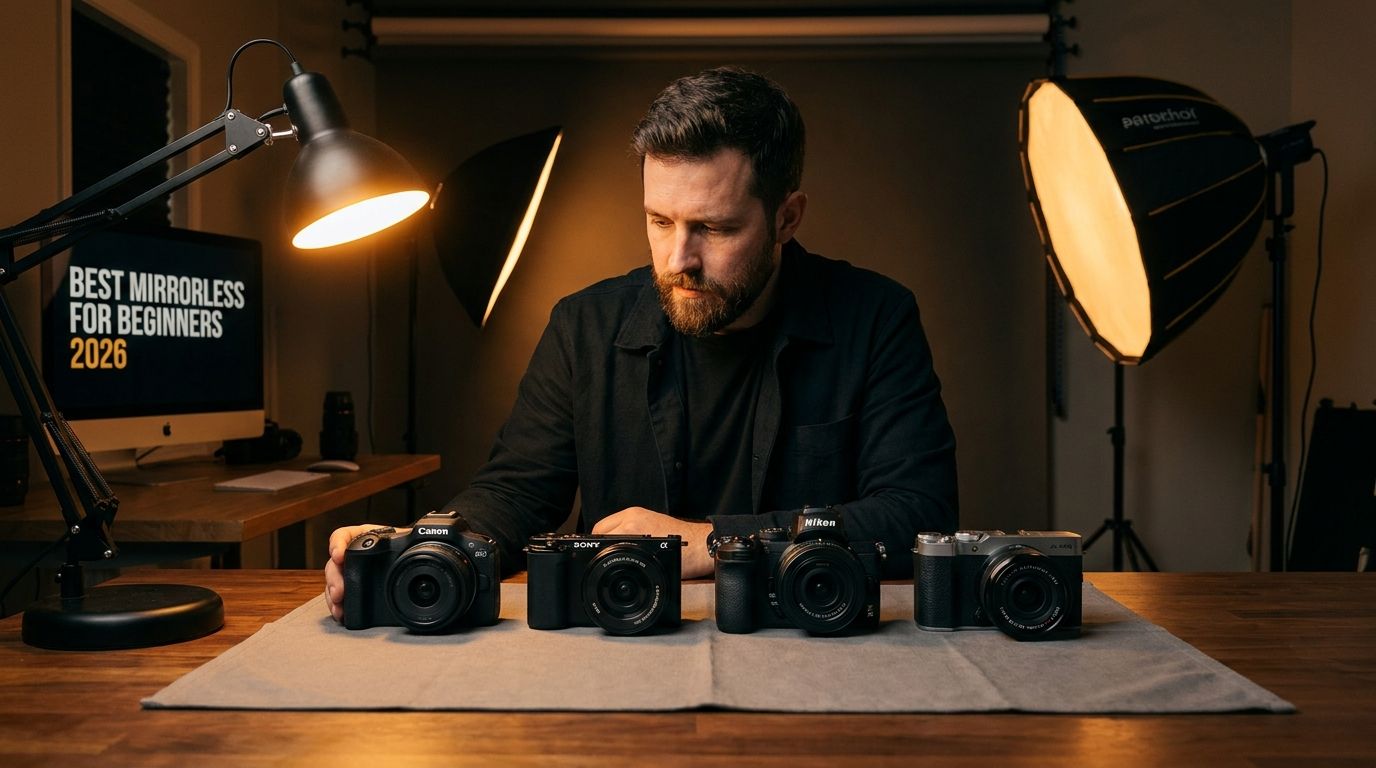
If you want to skip the explanations and just see the picks, here's the short version. I'll go deep on each one further down.
Our Top Picks by Use Case
- Canon EOS R50 — Best overall for beginners (around $700–$850 with kit lens). Current.
- Nikon Z50 II — Best for beginners who want room to grow into manual controls (around $800–$900 with kit lens). Current.
- Sony ZV-E10 II — Best for beginner vloggers and YouTubers (around $750–$900). Current.
- Fujifilm X-M5 — Best compact option for everyday carry and street (around $800 body only). Current.
- Canon EOS R100 — Best ultra-budget pick if you need to spend under $600 (around $500–$650 with kit lens). Current.
- OM System OM-5 — Best for outdoor and travel beginners (around $1,000 body only, weather-sealed). Check retailer for current stock.
⚠️ Prices change frequently. All prices in this guide are approximate ranges as of 2026 and fluctuate by retailer and time of year. Click through to live retailer pages (Canon, B&H, Adorama, Amazon) for current pricing before you buy.
What Is a Mirrorless Camera? (And Why It Matters for Beginners)
A mirrorless camera is a digital camera that captures light directly onto the image sensor without using the optical mirror box found in a DSLR. Instead of an optical viewfinder, you compose your shot using either an electronic viewfinder (EVF) or the rear LCD screen, which shows a real-time preview of exactly how your final image will look.
That single design change — no mirror — is why mirrorless cameras are lighter, thinner, and faster to autofocus than DSLRs of the same sensor size.
💡 Why mirrorless — not DSLR — is the starting point in 2026. Most major manufacturers have shifted their R&D focus to mirrorless systems, per CIPA shipment data. New autofocus tech, new lenses, and new bodies are almost exclusively mirrorless now. Buying into a mirrorless ecosystem today is the better long-term move.
How a Mirrorless Camera Works
- Without a mirror box, the image sensor is exposed to light continuously and captures the scene directly.
- The EVF or LCD shows a live preview of exactly what the sensor sees — including exposure, white balance, and depth-of-field changes before you press the shutter.
- This makes mirrorless bodies noticeably thinner and lighter than DSLRs of similar sensor size.
- Interchangeable lenses are the key advantage over a smartphone. A 50mm prime for portraits, a wide zoom for landscapes, and a telephoto for sports all use the same body.
Key Specs Beginners Actually Need to Understand
You'll see a lot of spec sheet jargon shopping for your first camera. Most of it doesn't matter yet. Here's what does:
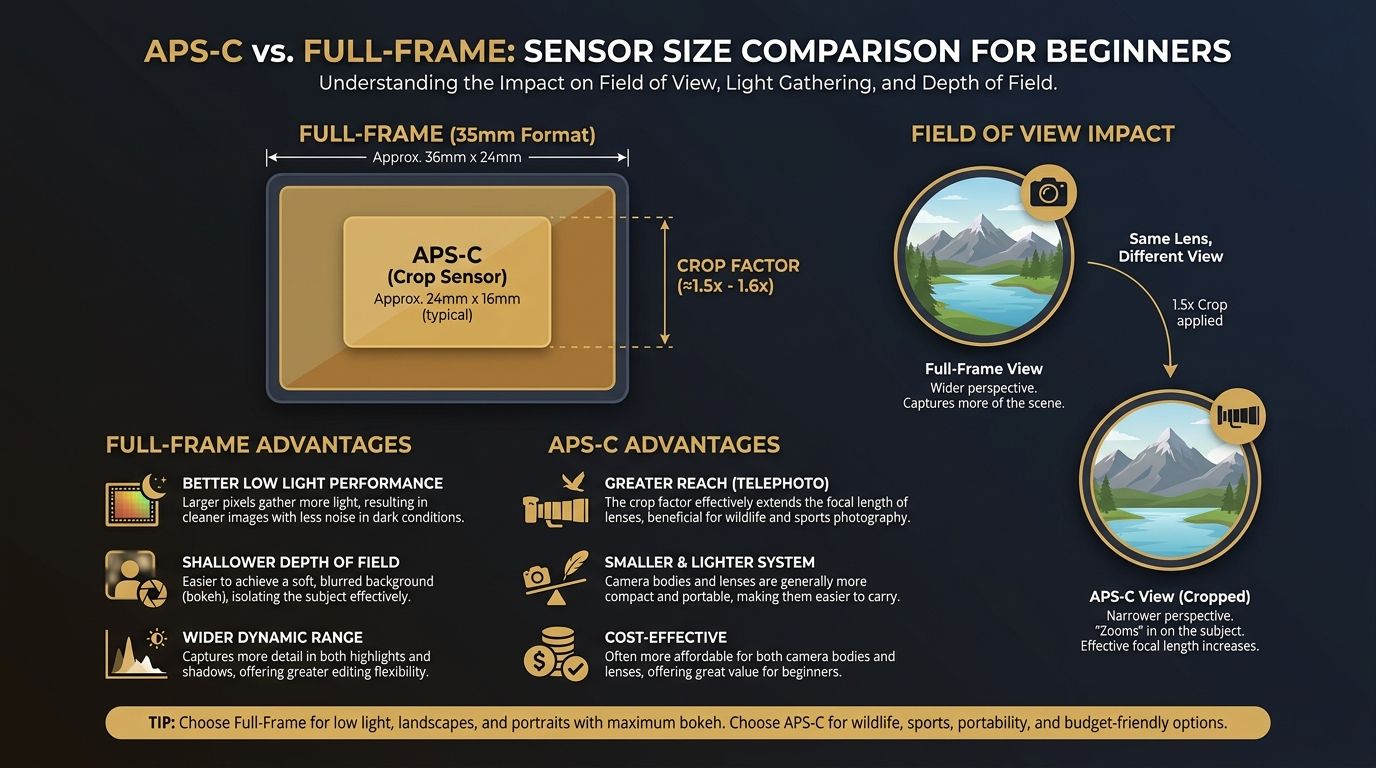
- Sensor size. APS-C is the sweet spot for beginners. Smaller bodies, cheaper lenses, and image quality that's more than good enough. Full-frame is bigger, heavier, and the lenses cost two to three times more.
- Megapixels. Anything in the 20–26MP range is plenty. Don't pay extra for higher MP at the beginner stage.
- Autofocus. Eye and subject detection AF is the single most useful feature for new shooters. It dramatically improves your keeper rate, especially for portraits and kids.
- Video resolution. 4K is now standard on every entry-level mirrorless. What you want to check is whether 4K is cropped (uses only part of the sensor) or full-width.
- Battery life. CIPA-rated shot counts vary from around 250 to 350 shots per charge on most APS-C bodies. Buy a spare battery on day one.
- Weight. Most APS-C bodies weigh 350–450g body only. Light enough to actually bring with you, which is the whole point.
How to Choose Your First Mirrorless Camera: A 5-Step Decision Framework
So how do you actually pick? Simple — just follow this 5-step process before you put anything in a cart.
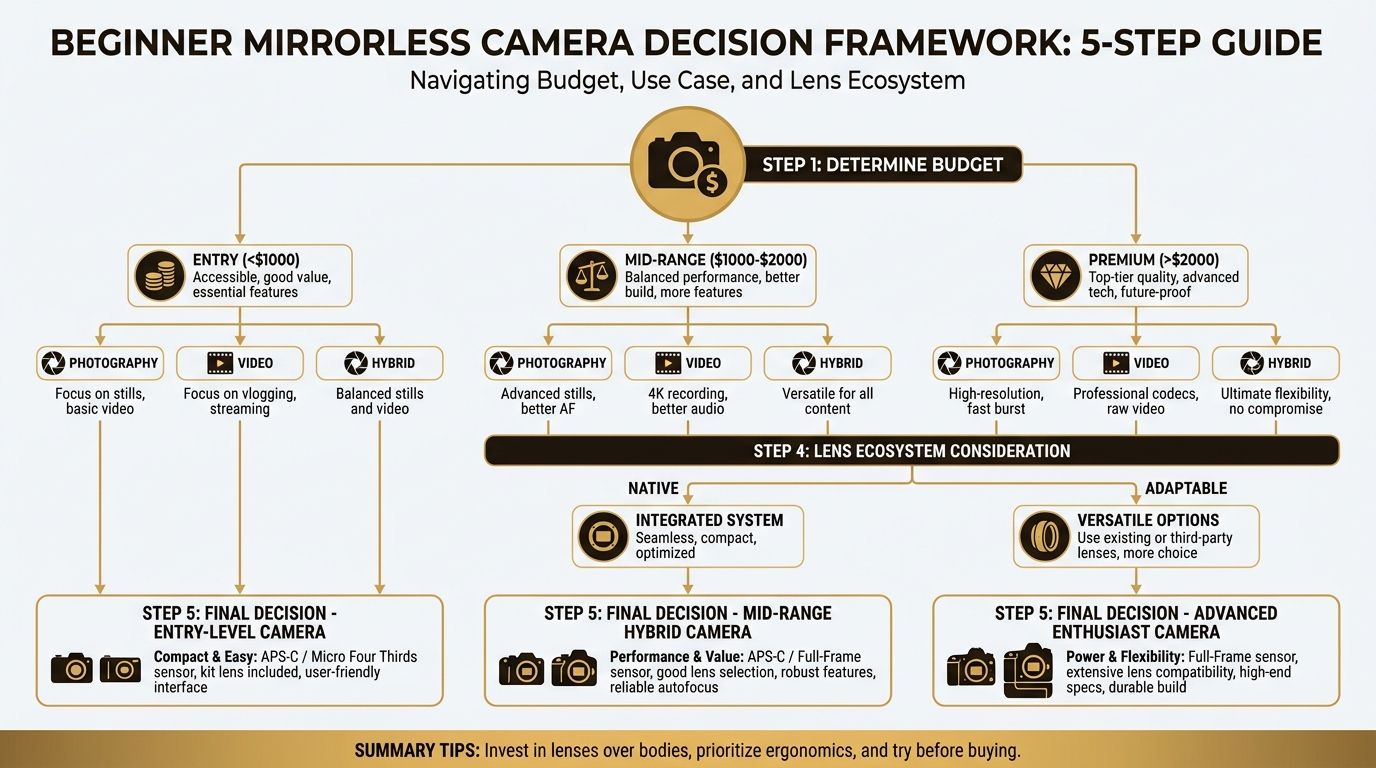
Beginner Mirrorless Camera Decision Checklist
- Set a realistic total budget (body + kit lens + accessories)
- Identify your primary use: still photos, video/vlogging, travel, or a mix
- Decide how important compact size is to you
- Consider which lens ecosystem you want to grow into
- Confirm your preferred shooting subjects (people, landscapes, sports, everyday life)
💡 Don't optimize for specs you won't use yet. High-speed burst modes, weather sealing, 6K video, log profiles — none of it matters until you've outgrown your first camera. Focus on ease of use and autofocus reliability first. You can always upgrade in two years.
Step 1 — Set Your Total Budget (Not Just the Body Price)
Budget $700–$1,200 for a complete beginner setup. That includes the body, a kit lens, an extra battery, and a fast SD card. Body-only prices are a trap because you can't shoot anything without a lens.
If you're tight on cash, used and refurbished bodies from KEH, MPB, or B&H Used will get you 30–50% off retail with a warranty.
Step 2 — Identify Your Primary Use Case
- Still photography first: Canon EOS R50 or Fujifilm X-M5
- Vlogging or YouTube: Sony ZV-E10 II (the fully articulating screen is non-negotiable here)
- Hybrid photo and video: Nikon Z50 II
- Outdoor or travel in rough conditions: OM System OM-5 (the only weather-sealed pick)
- Ultra-tight budget under $600: Canon EOS R100
Step 3 — Pick a Lens Ecosystem You Can Grow With
The body is a one-time purchase. Lenses are a 10-year investment. Choose carefully.
- Sony E-mount has the widest third-party lens support — Tamron, Sigma, Viltrox all make affordable, fast lenses. Best if you want cheap glass.
- Canon RF/RF-S has a growing first-party lineup but restricts most third-party autofocus lenses. Worth knowing upfront.
- Nikon Z-mount has strong first-party options and is opening up to third-party glass.
- Fujifilm X-mount has a well-curated native lineup with excellent prime lenses.
Step 4 — Decide on Sensor Size
APS-C is the right answer for almost every beginner. Smaller body, lighter lenses, lower total cost. Full-frame buys you marginal low-light improvement at significant cost penalty in both body and lens prices — not worth it until you're shooting professionally.
Micro Four Thirds (used by OM System) is even more compact but has a narrower native lens ecosystem in 2026.
Step 5 — Buy, Then Learn
- Buy the body + kit lens bundle, not separately. Better value every time.
- Add one extra battery, one fast UHS-I or UHS-II SD card (64GB minimum), and a strap.
- Start shooting in Auto or Scene modes, then move to Aperture Priority (Av/A) once you're comfortable.
- Resist upgrading until you can clearly name what your current camera can't do.
The Best Mirrorless Cameras for Beginners in 2026: Full Reviews
The best mirrorless camera for most beginners in 2026 is the Canon EOS R50 — it nails the balance of beginner-friendly menus, reliable Dual Pixel autofocus, compact size, and a kit lens that's actually usable. If you're vlogging, jump to the Sony ZV-E10 II. Here are all six picks reviewed.
💡 How we evaluated these cameras. Every pick was scored on ease of use, autofocus reliability, kit lens quality, video capability, CIPA-rated battery life, lens ecosystem breadth, and price-to-value for someone buying their first interchangeable-lens camera. All specs are pulled from manufacturer pages — linked inline so you can verify.
1. Canon EOS R50 — Best Overall Beginner Mirrorless Camera
The Canon EOS R50 is the camera I recommend to 80% of beginners who ask me what to buy. The guided UI walks you through every setting in plain English, Canon's Dual Pixel CMOS AF II is genuinely excellent at tracking eyes and faces, and the 18-45mm kit lens is sharper than most kit lenses have any right to be.
Key specs (Canon EOS R50 spec page): - APS-C sensor, approximately 24.2MP - 4K video (verify crop factor on Canon's spec page) - CIPA-rated battery life (refer to Canon spec page for current figure) - Weight: approximately 375g body only
Pros: - Intuitive beginner menus and guided shooting mode - Strong subject and eye detection autofocus - Compact and light enough to carry daily - 4K video out of the box - Excellent value with the 18-45mm kit lens bundle
Cons: - 4K is cropped (verify with Canon's spec page) - No in-body image stabilization (IBIS) - RF-S native lens selection is still growing
Best for: First-time photographers who want a reliable all-rounder without a steep learning curve.
Approximate price: $700–$850 with 18-45mm kit lens. Check current pricing at B&H, Adorama, or Canon directly.
2. Nikon Z50 II — Best for Beginners Who Want to Grow
The Nikon Z50 II is what I'd buy if I knew I was going to take photography seriously within a year. The physical dials, the chunky grip, and the surprisingly capable subject detection AF (inherited from Nikon's pro bodies) make it a camera you grow into rather than out of.
Key specs (Nikon Z50 II spec page): - APS-C DX sensor, approximately 20.9MP - 4K video - CIPA-rated battery life (refer to Nikon spec page) - Weight: approximately 415g body only
Pros: - Ergonomic grip with real physical dials - Best-in-class subject detection AF for the price - 4K video without a crop - Z-mount third-party lens support is opening up
Cons: - Screen tilts rather than fully articulates (verify on spec page) - No in-body image stabilization - Native DX lens selection is smaller than Sony E
Best for: Beginners who are confident they'll develop manual shooting skills within a year and want a body that won't bottleneck them.
Approximate price: $800–$900 with 16-50mm kit lens.
3. Sony ZV-E10 II — Best for Beginner Vloggers and Content Creators
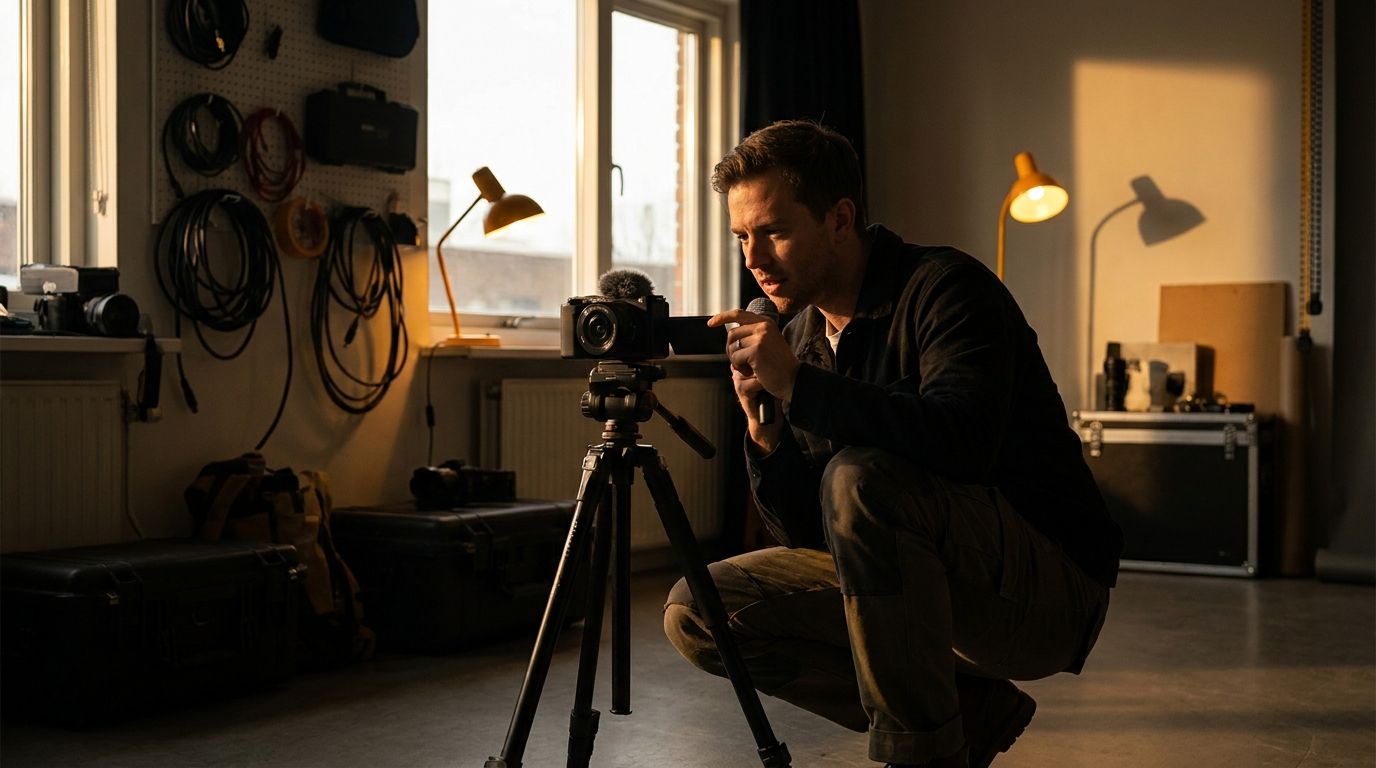
If you're making YouTube videos, the Sony ZV-E10 II is the only camera on this list designed from the ground up for video creators. The fully articulating screen flips out to face you, the Real-time Eye AF is the best in the price range for tracking moving subjects, and the built-in three-capsule microphone is usable straight out of the box.
Key specs (Sony ZV-E10 II spec page): - APS-C sensor, approximately 26MP - 4K video (verify crop factor on Sony's spec page) - CIPA-rated battery life (refer to Sony spec page) - Built-in directional microphone, headphone and mic jacks
Pros: - Fully articulating touchscreen (essential for vlogging) - Real-time Eye AF for video - Widest third-party lens support of any mount (Tamron, Sigma, Viltrox) - Compact body
Cons: - No electronic viewfinder - Battery life is on the shorter side — buy two spares - Often sold body-only, lens is a separate cost
Best for: Beginner YouTubers, vloggers, and creators who shoot primarily video.
Approximate price: $750–$900 body only.
4. Fujifilm X-M5 — Best Compact Option for Beginners
The Fujifilm X-M5 is the camera you'll actually bring with you. It's the smallest and lightest body in this roundup, and Fujifilm's film simulations (Provia, Velvia, Classic Chrome, Acros) produce JPEGs that look good straight out of camera with zero editing.
Key specs (Fujifilm X-M5 spec page): - APS-C X-Trans sensor, approximately 26MP - 6.2K video capability (verify settings limitations) - CIPA-rated battery life (refer to Fujifilm spec page) - Weight: approximately 250g body only
Pros: - Smallest, lightest body in this roundup - Exceptional JPEG color and film simulations - Strong prime lens selection on X-mount - Fully articulating screen
Cons: - X-Trans sensor requires compatible RAW software (Lightroom, Capture One) - No in-body image stabilization - Smaller native lens ecosystem than Sony
Best for: Beginners drawn to aesthetics — street photography, travel, everyday carry — who want a camera they'll actually use.
Approximate price: around $800 body only.
5. Canon EOS R100 — Best Ultra-Budget Mirrorless for Beginners
The Canon EOS R100 is the cheapest way into a new mirrorless system. It uses the same RF-S mount as the R50, so any lenses you buy will move forward with you if you upgrade later. The trade-off is an older autofocus system without the advanced subject detection of the R50.
Key specs: - APS-C sensor, approximately 24.1MP - 4K video (cropped — verify on Canon's spec page) - CIPA-rated battery life (refer to manufacturer) - Lightest body in Canon's RF lineup
Pros: - Lowest entry price for a new Canon mirrorless - Compact and light - Lens-compatible with the R50 if you upgrade - Reliable Dual Pixel AF (basic version)
Cons: - Older AF system without advanced subject detection - No fully articulating screen - Limited video features at 4K
Best for: Strict-budget buyers who want a new camera under $650 with kit lens.
Approximate price: $500–$650 with 18-45mm kit lens.
6. OM System OM-5 — Best for Outdoor and Adventure Beginners
If you hike, travel, or shoot in conditions where weather is a question, the OM System OM-5 is the only pick here built for it. IPX4 splash and dust resistance, in-body image stabilization rated up to around 7.5 stops, and a Micro Four Thirds lens system that's lighter than anything in APS-C land.
Key specs: - Micro Four Thirds sensor, approximately 20.4MP - 4K video - Class-leading IBIS (verify rating on OM System spec page) - IPX4 weather and splash resistance - Weight: approximately 414g body only
Pros: - Best-in-class IBIS for handheld shots - Weather-sealed body - Compact MFT lenses (a 300mm equivalent telephoto weighs a fraction of an APS-C equivalent) - Strong outdoor and wildlife lens options
Cons: - Smaller sensor means slightly reduced low-light performance - MFT ecosystem is smaller than Sony E or Canon RF - Menu system has a learning curve
Best for: Outdoor enthusiasts, hikers, and travelers who need rugged and lightweight.
Approximate price: around $900–$1,100 body only. Check retailer for current stock.
Side-by-Side Comparison Table: All Beginner Picks at a Glance
| Camera | Sensor Size | Approx. Price (with kit lens) | Best For | Standout Feature | Availability |
|---|---|---|---|---|---|
| Canon EOS R50 | APS-C | $700–$850 | Overall beginners | Dual Pixel AF II + guided UI | Current |
| Nikon Z50 II | APS-C (DX) | $800–$900 | Beginners ready to grow | Physical dials + subject AF | Current |
| Sony ZV-E10 II | APS-C | $750–$900 (body) | Vloggers / YouTube | Fully articulating screen | Current |
| Fujifilm X-M5 | APS-C (X-Trans) | ~$800 (body) | Street, travel, daily carry | Film simulations + 250g body | Current |
| Canon EOS R100 | APS-C | $500–$650 | Strict budget | Lowest new Canon price | Current |
| OM System OM-5 | Micro Four Thirds | $900–$1,100 (body) | Outdoor / travel | Weather sealing + 7.5-stop IBIS | Check retailer |
⚠️ Prices are approximate. All figures reflect typical retail ranges as of 2026 and shift with sales, bundles, and rebates. Check live retailer pages before buying.
Lens Ecosystem Comparison: Canon RF vs Sony E vs Nikon Z vs Fujifilm X
Here's the part most beginner guides skip: the lens ecosystem you buy into matters more than the body itself. Bodies depreciate fast. Good lenses hold value for a decade.
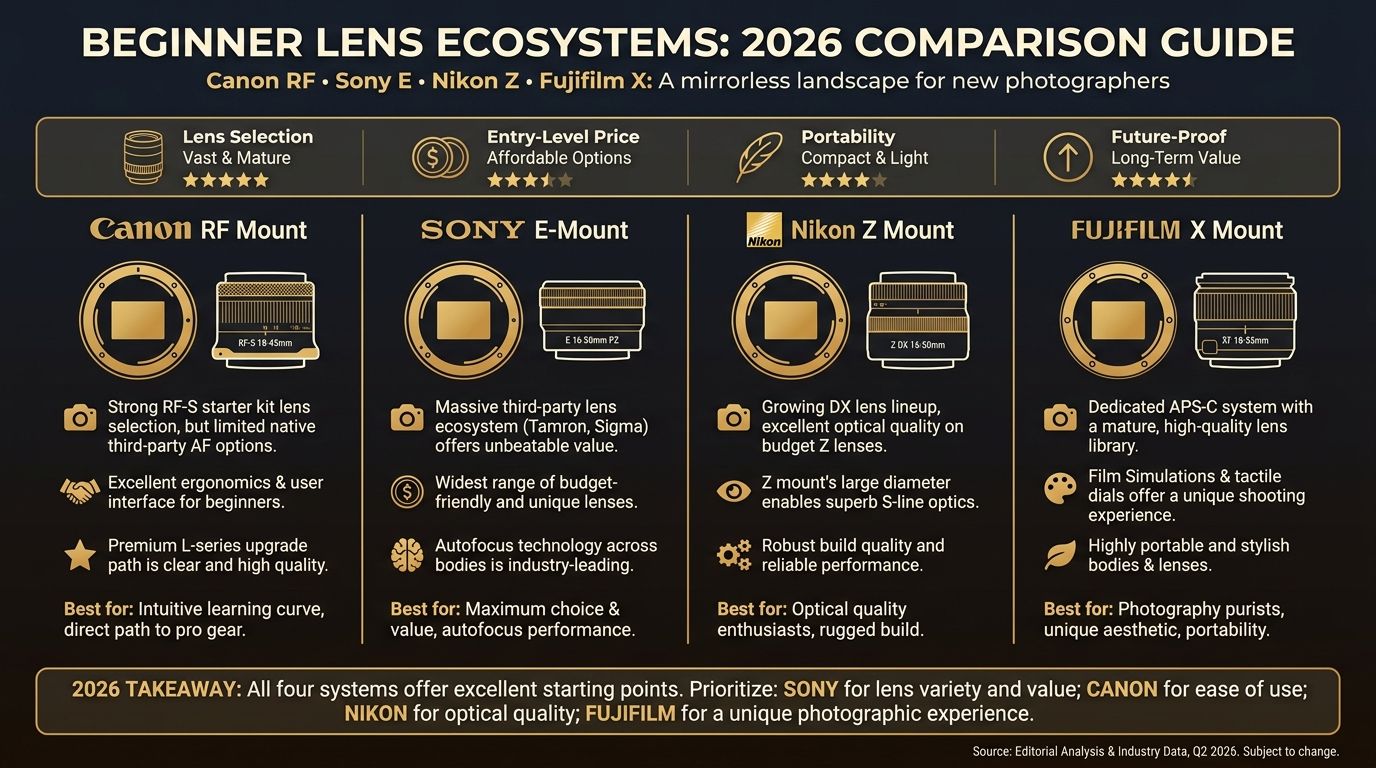
| Brand / Mount | Native Lens Count (approx.) | Affordable Lenses Under ~$500 | Third-Party Support | Used Market Depth | Best For Beginners |
|---|---|---|---|---|---|
| Canon RF / RF-S | Growing (verify Canon roadmap) | Limited but expanding | Restricted (most third-party AF lenses not allowed) | Moderate | Beginners who want first-party simplicity |
| Sony E-mount | Largest native + third-party lineup | Many options from Sigma, Tamron, Viltrox | Excellent | Deep | Budget lens buyers, vloggers |
| Nikon Z-mount | Solid first-party, growing third-party | Modest selection under $500 | Improving | Shallow but growing | Beginners committed to Nikon long-term |
| Fujifilm X-mount | Well-curated, prime-heavy | Strong prime lens value | Limited but growing | Moderate | Beginners who love primes and street/travel |
Lens counts and third-party support change frequently. Verify on each manufacturer's lens roadmap page before buying.
⚠️ Don't get locked in without knowing. Switching ecosystems later means selling all your lenses at a loss and rebuying. The cost of switching is usually higher than the cost of the original body. Pick the ecosystem with affordable lenses available now, not just promised on a roadmap.
Can I Use My Old DSLR Lenses on a Mirrorless Camera?
Yes, with the right adapter — though there are caveats.
- Canon EF to RF: Canon's official EF-EOS R adapter works reliably with full autofocus on RF-mount bodies.
- Nikon F to Z: Nikon's FTZ II adapter works well with most modern F-mount lenses.
- Sony A-mount to E-mount: Sony LA-EA5 adapter, AF performance varies by lens.
- Cross-brand (e.g., Canon EF on Sony E): Third-party adapters from Metabones, Sigma MC-11, and Viltrox exist, but AF reliability varies lens by lens. Research the specific combo before buying.
If you're starting fresh with no existing lenses, just buy native mirrorless glass. The AF experience is always better.
What Will It Really Cost? Total Budget Breakdown for Beginners
This is where most beginner guides leave you hanging. You don't just buy a camera — you buy a system. Let's break down the actual costs.
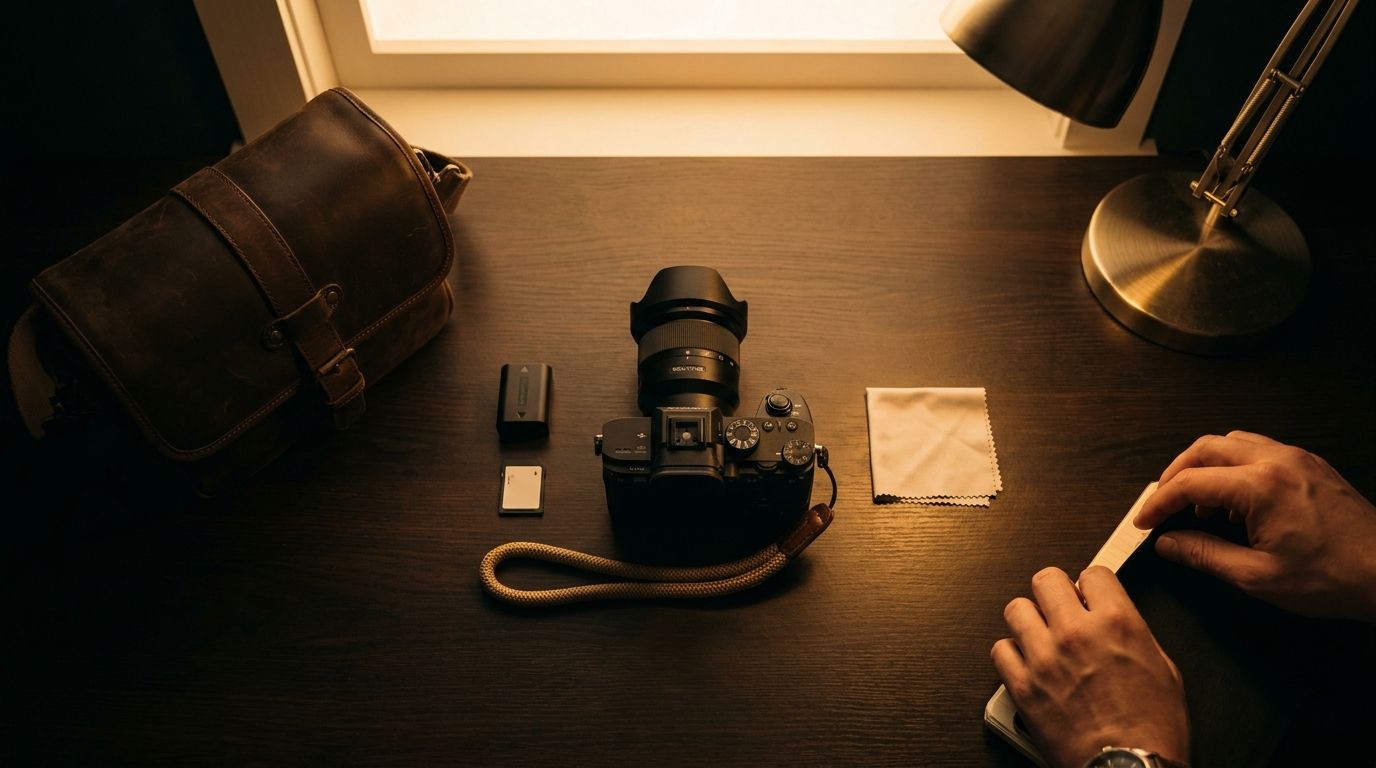
| Item | Budget Setup (est.) | Mid-Range Setup (est.) | Notes |
|---|---|---|---|
| Camera body + kit lens | $550–$650 (e.g., R100) | $800–$900 (e.g., R50, Z50 II) | Always buy as a bundle |
| Extra battery | $30–$50 (third-party) | $60–$80 (OEM) | Wasabi Power and similar are reliable |
| 64GB+ fast SD card | $20–$30 | $35–$60 (UHS-II) | SanDisk Extreme or Sony Tough |
| Camera bag or strap | $25–$40 | $50–$80 | Peak Design and similar |
| Screen protector / extras | $10–$20 | $20–$40 | Optional but recommended |
| **Approximate total** | **~$700** | **~$1,200** | Excludes optional extras |
Beginner Starter Kit Checklist
- Camera body + kit lens bundle (better value than buying separately)
- Extra battery (OEM or quality third-party like Wasabi Power)
- 64GB+ UHS-I or UHS-II SD card (SanDisk Extreme or Sony Tough)
- Camera bag or protective case
- Wrist or neck strap
- Optional: UV filter for lens protection
- Optional: compact LED light or directional microphone if vlogging
💡 Buy used and save 30–50%. Certified used cameras from KEH Camera, MPB, and B&H Used are graded, tested, and warranty-backed. KEH uses a clear grading scale — aim for "Excellent" or "Excellent+" condition. A used R50 in Excellent condition often runs $550–$650, saving you roughly $200 versus new. Especially worth it if you suspect you'll upgrade within two years.
Estimated Used vs New Price Ranges by Camera
Used pricing moves constantly — these are directional ranges only. Always check current listings on KEH or MPB before buying.
- Canon EOS R50 used: approximately $550–$650 (verify on KEH/MPB at time of purchase)
- Nikon Z50 II used: still close to retail given recent release
- Sony ZV-E10 II used: limited used inventory, prices close to retail
- Fujifilm X-M5 used: limited used inventory
- Canon EOS R100 used: approximately $400–$500
- OM System OM-5 used: approximately $700–$850
Used kit lenses are also widely available and in good condition are perfectly reliable for beginners. If a camera you want shows up as discontinued or limited availability, the used market is often your best path.
Mirrorless vs Smartphone vs DSLR: Do You Actually Need a Mirrorless Camera?
Honest question: do you actually need a dedicated camera? Sometimes the right answer is no.
| Feature | Mirrorless | Smartphone | Used DSLR |
|---|---|---|---|
| Image quality ceiling | High | Good in good light | High |
| Lens flexibility | Excellent | Fixed lenses only | Excellent (used glass cheap) |
| Video capability | 4K standard | 4K+ standard | Varies, often limited |
| Ease of use for beginners | High (guided modes) | Highest | Medium |
| Portability | Compact | Always with you | Larger and heavier |
| Approximate starting cost | $700–$1,200 | Already own one | $200–$400 used |
📌 Still not sure? Start here. If you mostly want to share photos to Instagram and don't want to carry a separate camera, your smartphone is probably enough. If you want to learn photography as a skill, control depth of field, shoot serious video for YouTube, or print large, a mirrorless camera will give you capabilities your phone genuinely cannot replicate.
When Your Smartphone Is Enough
- Modern flagship phones (iPhone Pro, Pixel Pro, Galaxy Ultra) produce excellent photos in daylight.
- Computational photography — portrait mode, night mode, HDR — has narrowed the casual-shooting gap significantly.
- If you're not planning to print large, learn manual exposure, or buy additional lenses, a dedicated camera may not meaningfully improve your output.
When a Used DSLR Makes Sense
- Entry-level used DSLRs like the Canon Rebel T7/T8i or Nikon D3500 are available for $200–$350 used and still deliver excellent image quality.
- Physical dials and an optical viewfinder are great learning tools.
- Battery life on DSLRs is typically much longer than mirrorless — often 600+ shots per charge.
- However, most manufacturers have stopped developing new DSLR models based on their product announcements through 2026, so you're buying into a maturing rather than growing ecosystem.
- A DSLR is a smart choice if your budget is extremely tight and you plan to eventually adapt your lenses to a mirrorless body later.
Tips for Getting the Most Out of Your First Mirrorless Camera
You've bought the camera. Now what? Here's how to actually get good with it.
💡 The single best habit you can build. Shoot every day, even for five minutes. Consistent practice with your actual camera (not your phone) builds muscle memory faster than any YouTube tutorial. Put it on Aperture Priority and shoot something — anything — daily for 30 days.
Start in Auto, Then Move to Aperture Priority
- Auto mode isn't cheating. It's a learning tool. Watch what the camera chooses and ask yourself why.
- Aperture Priority (Av or A mode) is the right next step. You set the aperture (depth of field), the camera handles the rest.
- Don't jump to full Manual until you genuinely understand how aperture, shutter speed, and ISO interact. There's no rush.
Build the Right Habits Early
- Always charge your spare battery before a shoot. Mirrorless drains batteries faster than DSLRs.
- Format your SD card in the camera, not on a computer. This prevents file system errors.
- Shoot RAW + JPEG while learning. You get the editing flexibility of RAW plus instantly shareable JPEGs.
- Use the in-camera guides. Most beginner mirrorless cameras have a guided mode explaining what each setting does. Use it for a month, then turn it off.
- Lock down focus settings early. Set continuous AF with eye detection as your default for people shots.
- Back up your photos weekly. External drive or cloud, doesn't matter — just don't lose your work.
- Print one photo a month. Sounds old-school, but printing forces you to evaluate your work differently than scrolling on a phone.
Frequently Asked Questions: Beginner Mirrorless Cameras
What is the best mirrorless camera for a complete beginner?
For most beginners, the Canon EOS R50 is the top overall pick thanks to its intuitive interface and reliable Dual Pixel autofocus. For beginner vloggers, the Sony ZV-E10 II is the better choice. Both are available in the $700–$900 range with a kit lens. Prices are approximate and vary by retailer.
How much should a beginner spend on a mirrorless camera?
Plan for a total budget of $700–$1,200 to cover the camera body, kit lens, an extra battery, and a fast SD card. Buying a certified used or refurbished body from KEH or MPB can reduce costs by 30–50% without meaningfully compromising quality.
Is APS-C or full-frame better for beginners?
APS-C is strongly recommended for beginners. Full-frame cameras and their compatible lenses are significantly more expensive, heavier, and offer no practical image quality advantage at the beginner stage. APS-C sensors deliver excellent results for learning, travel, and everyday photography.
Do I need a mirrorless camera or is my smartphone enough?
If your goal is sharing to social media in good light, a modern smartphone is likely sufficient. If you want to learn manual photography, control depth of field, shoot video for YouTube, or print large photos, a mirrorless camera offers capabilities your phone cannot replicate.
Which mirrorless brand is best for beginners — Canon, Sony, Nikon, or Fujifilm?
Each brand has specific strengths. Canon offers the most beginner-friendly menus and color science. Sony provides the widest third-party lens ecosystem. Nikon delivers excellent ergonomics and subject detection. Fujifilm stands out for compact size and film simulation colors. The best brand depends on your use case and budget, not a universal ranking.
Can I use old DSLR lenses on a mirrorless camera?
Yes, with an official mount adapter. Canon EF lenses adapt to RF-mount cameras using Canon's EF-EOS R adapter, and Nikon F lenses adapt to Z-mount cameras using Nikon's FTZ II adapter. Autofocus typically works well with first-party adapters. Third-party adapters for cross-brand combinations exist but AF reliability varies by lens.
What is the difference between a mirrorless camera and a DSLR?
A DSLR uses a physical mirror to redirect light to an optical viewfinder. A mirrorless camera has no mirror, sending light directly to the sensor at all times. This makes mirrorless bodies lighter and thinner, with real-time exposure preview through the EVF or LCD. Most major manufacturers have stopped developing new DSLR models and are focusing on mirrorless systems.
What accessories does a beginner mirrorless camera need?
At minimum: one extra battery, a 64GB+ fast SD card (UHS-I or UHS-II), and a camera bag or strap. Optional but useful additions include a UV filter for lens protection and, for vloggers, a compact directional microphone like the Rode VideoMicro.
Is full frame worth it for beginners?
Full-frame is not recommended for most beginners. The body costs significantly more, the lenses cost two to three times what APS-C lenses cost, and the practical image quality benefit is minimal at the beginner skill level. Start with APS-C and upgrade only when you can clearly name what your current sensor can't do.
Sources
- DPReview: Best Mirrorless Camera Buying Guide
- RTINGS: Best Mirrorless Cameras for Beginners
- Canon EOS R50 Official Spec Page
- Sony ZV-E10 II Official Product Page
- Nikon Z50 II Official Spec Page
- Fujifilm X-M5 Official Product Page
- CIPA Global Shipment Data Report
- B&H Explora: Mirrorless Cameras for Beginners
- PetaPixel: Best Mirrorless Cameras
- KEH Camera: Certified Used Cameras