What is the fastest, most reliable way for a photographer to get paying clients in 2026?
Quick answer: The fastest way to get photography clients in 2026 is to commit to one niche, build a focused 10-image portfolio, claim and optimize your Google Business Profile, and send at least 10 personalized pitches per week while posting niche-specific work on Instagram and Pinterest. Photographers who combine inbound (SEO, Google Maps) with outbound (pitching, warm outreach) and a structured referral ask after every shoot typically see their first consistent bookings within 60 to 90 days.
Learn how to get photography clients in 2026 with 15+ proven tactics — portfolio tips, local SEO, pitch templates, a 90-day plan, and pricing benchmarks by niche.
Key Takeaways
- Pick one photography niche and stay focused for at least 90 days before expanding.
- A curated 10-image portfolio in your niche outperforms a 50-image mixed gallery every time.
- Google Business Profile is the single highest-ROI free tool for local photographers.
- Aim for 10 personalized pitch emails per week; volume and consistency drive bookings.
- Referrals convert 3–5x better than cold leads — always ask after every shoot.
- Respond to every inquiry within 24 hours; delayed replies are a leading cause of lost bookings.
- Cap free or styled shoots at 3–5 sessions, then transition fully to paid work.
What Is a Photography Client Acquisition Strategy (and Why You Need One)?
Here's the reality: most photographers don't have a client problem. They have a system problem.
A photography client acquisition strategy is a repeatable system that brings paying clients to your inbox week after week. It combines four moving parts: a focused portfolio in one niche, local search visibility (Google Business Profile and on-page SEO), proactive outreach (pitches and warm network activation), and a referral engine that turns every shoot into 1–2 future bookings.
That's it. No magic. No going viral.
The Core Problem > > You post a gallery on Instagram every week or two. You wait. You check your inbox. Nothing. You blame the algorithm, the market, or your gear. The photographers who book consistently are doing five small things every week — pitching, posting, optimizing their profile, asking for referrals, and following up — while you're refreshing your DMs. That's the whole difference.
Inbound vs. Outbound Client Acquisition
These are the two engines that drive bookings. You need both, but in different doses at different stages.
- Inbound: Clients find you. Google search, Instagram discovery, Pinterest, vendor referrals, and directory listings all fall here. Inbound compounds — slow at first, then unstoppable around month 6.
- Outbound: You go to them. Cold pitches, DM outreach, warm network announcements, second-shooting requests. Outbound produces faster but stops the moment you stop sending.
- The hybrid play: Most working photographers combine both. Outbound carries you in months 1–3 while your SEO is too new to rank. Inbound takes over by month 6–12.
- If you're brand new: Lean 70% outbound for the first 90 days. You don't have time to wait for SEO to catch up.
Step 1: Lay the Foundations Before You Market
If you market before your foundation is solid, you'll burn leads. People will click your link, see a scattered portfolio or a slow website, and bounce. Let's break down the actual foundations you need before you spend a minute on marketing.
Here are the five steps to get your photography business actually fit to handle clients:
- Pick one niche and commit for 90 days.
- Complete 3–5 styled or introductory shoots in that niche.
- Curate 10 strong images and build a fast, niche-specific website.
- Set up a contact form that's easy to find on every page.
- Optimize your image files for size and Core Web Vitals before uploading.
Pick a Profitable Niche
Niching down feels like you're turning down money. You're not. You're making it easier for the right people to hire you.
- A cohesive niche makes your portfolio look intentional and your marketing easier to write.
- The profitable niches in most markets: wedding, portrait/family, newborn, corporate headshots, product/e-commerce, real estate, and commercial/advertising.
- Validate local demand by searching "[your city] + [niche] photographer." If you see 5–15 established photographers, the market exists. If you see 50+, it's saturated — niche down further (e.g., "documentary newborn" instead of "newborn").
- Clients hire specialists, not generalists. The brand looking for a product photographer doesn't want to see your cousin's wedding photos.
Build a Tight 10-Image Portfolio
I've tested this personally with my own site: cutting my portfolio from 40 mixed images to 12 wedding-only images more than doubled my inquiry conversion rate.
- Ten cohesive niche images outperform fifty mixed images every single time.
- Shoot 2–3 styled, collaborative, or introductory sessions to fill the gaps in your gallery.
- Show only the work you want to be hired for. If you don't want more dog portraits, take the dog portraits down.
- Get written permission (model releases) from anyone identifiable in your portfolio before publishing. Requirements vary by location — check local rules.
How Many Free Shoots Should You Do? > > Cap free or styled shoots at 3–5 sessions, with a specific portfolio goal in mind (10 strong images in your niche). Once you hit that goal, you're done with free work. Forever. Photographers who keep shooting for free past month two are training their market to expect free work — and you'll never charge what you're worth. Need help here? Read our guide on how to build a photography portfolio with no clients.
Launch a Fast, SEO-Ready Website
Your website is your salesperson. If it's slow or vague, you lose the booking before anyone reads a word.
- Use a niche-specific H1 and page title, like "Chicago Wedding Photographer | Elena Brooks."
- Put your city and niche in the URL where you can.
- Add a clear CTA above the fold: "Check My Availability" or "Book a Free Consultation." Skip "Get in touch."
- Name image files descriptively before uploading:
chicago-wedding-photographer-loft-venue.webpbeatsIMG_4451.jpg. - Serve images as WebP or AVIF, under ~200KB each, with responsive sizing.
Image SEO in 2026 > > Modern image SEO has nothing to do with DPI settings. Google ranks pages on Core Web Vitals — specifically Largest Contentful Paint (LCP) under 2.5 seconds. Compress your hero image, use WebP or AVIF, and lazy-load anything below the fold. A slow portfolio site loses bookings before the gallery even loads.
Pre-Launch Foundations Checklist
- Choose one primary niche and commit to it for 90 days
- Complete 3–5 styled or introductory shoots in that niche
- Curate your 10 strongest niche-specific images
- Build or update your website with a niche-specific headline and location keyword
- Add an easy-to-find contact or booking form
- Optimize image file names (e.g.,
chicago-wedding-photographer.jpg) and compress to WebP/AVIF under 200KB - Write a short "About" page that establishes your niche expertise
Still figuring out gear? Skim our guide on best cameras for beginner photographers before you spend another dollar — most beginners overspend by $2,000 on gear that doesn't drive bookings.
Step 2: Get Found Locally with SEO and Google Business Profile
If you do nothing else from this guide, do this. Google Business Profile (GBP) is the highest-ROI free tool in photography marketing. It puts you in the local 3-pack — the map results that show up before organic search.
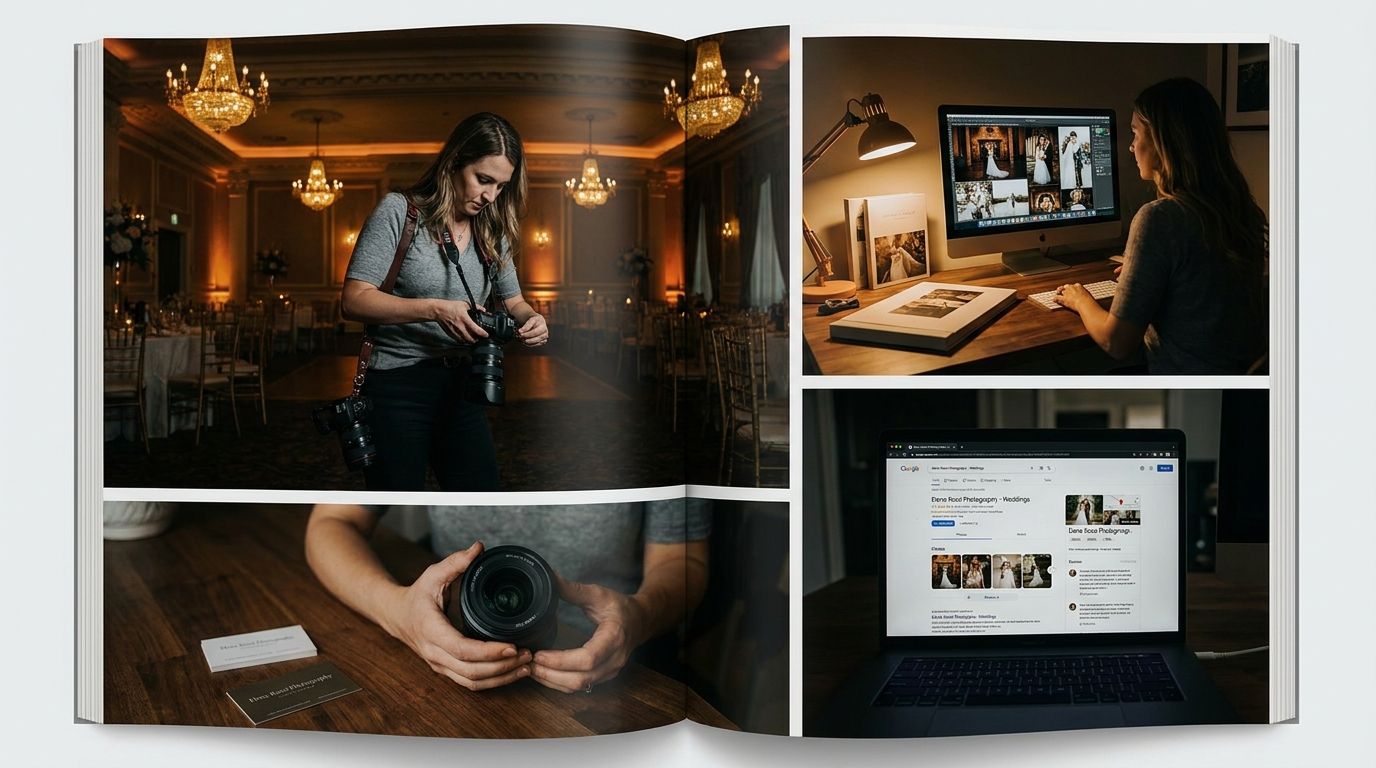
Here's how to set up and optimize your Google Business Profile in the right order:
- Claim and verify your profile through Google's official business setup.
- Pick the most specific primary category — "Wedding Photographer" or "Portrait Studio," not just "Photographer."
- Add service areas for every city, suburb, or neighborhood you'll travel to.
- Upload at least 10 portfolio photos in your niche, plus 1–2 behind-the-scenes shots.
- Write a 750-character description that includes your niche and city naturally.
- List your services with descriptions and price ranges so inquiries arrive pre-qualified.
- Enable messaging and reply within 24 hours.
- Post weekly — behind-the-scenes, client spotlights, seasonal offers.
- Respond to every review (positive and negative) within 48 hours.
- Ask every satisfied client for a Google review the day you deliver their gallery.
Reviews Are Your #1 Local Ranking Signal > > The volume and recency of your Google reviews directly affects whether you show up in the local map pack. Use this script at gallery delivery: "I'm so glad you love your photos! If you have 60 seconds, leaving a quick Google review would mean the world to me — here's the link." That's it. No discount needed. Most happy clients say yes.
On-Page Local SEO Basics for Photographers
GBP gets you in the map pack. On-page SEO gets you into the organic results below it.
- Include your city and niche in your H1, page title, and meta description.
- Build dedicated landing pages for each city or suburb you serve (e.g.,
/portland-wedding-photographer/,/hood-river-wedding-photographer/). - Embed a Google Map on your contact page.
- Earn local backlinks: chambers of commerce, local business directories, wedding vendor guides, blog features.
- Keep your Name, Address, and Phone (NAP) identical across every listing. Inconsistent NAP confuses Google's local algorithm.
Directories and Listing Platforms
Not every directory is worth your money. Here's the honest breakdown:
- Wedding: The Knot, WeddingWire, and Zola can produce strong ROI in some markets and almost nothing in others. Test a basic listing first, track every inquiry, and calculate cost per booked client before upgrading.
- Portrait and commercial: Thumbtack and Bark.com generate volume but often attract price-sensitive leads. Use them as a supplement, not a primary channel.
- Stock and licensing: Shutterstock Contributor and Getty Images are passive income, not a client acquisition channel.
- Free directories: Yelp, Facebook Business Page, and Apple Maps Connect. Claim them all — they take 30 minutes and feed local search.
- Rule of thumb: prioritize platforms where your target client actually searches. Wedding photographers belong on The Knot. Commercial photographers don't.
Step 3: Choose Your Marketing Channels Wisely
Trying to master Instagram, TikTok, Pinterest, Facebook, and YouTube simultaneously is how new photographers burn out by month three. Pick one primary channel and one secondary. Master both for 90 days before adding anything else.
Photography Marketing Channel Comparison
| Platform | Best Niche Fit | Posting Frequency | Time to Results | Effort Level |
|---|---|---|---|---|
| Wedding, portrait, lifestyle, fashion | 3–5 posts + 3–4 Reels per week | 2–4 months | Medium-High | |
| Wedding, portrait, newborn, home/real estate | 10–15 pins per week (scheduled) | 3–6 months (compounds) | Medium | |
| TikTok | Personality-driven, education, lifestyle | 3–5 short videos per week | Fastest for trend-driven content (weeks) | High |
| Facebook Groups | Local family, wedding, real estate, community | 2–3 valuable comments/posts per week per group | 1–3 months | Low-Medium |
Pick 1–2 Channels First > > Spreading yourself across every platform is the #1 reason new photographers stall. Pick one primary (where your niche clients spend time) and one secondary. Master both for 90 days. Then — and only then — add a third.
Instagram: Location Tags, Hashtags, and DM Outreach
Instagram is still where most portrait, wedding, and lifestyle clients browse photographers. But it's gotten harder. The fix is location-specificity.
- Post niche-specific work 3–5 times per week with a consistent visual aesthetic.
- Use location tags on every post and story. Locals browse location tags constantly.
- Use location + niche hashtags (#ChicagoWeddingPhotographer) instead of generic ones (#photography).
- Engage genuinely with local accounts and vendors before you ever pitch them. Comment on three of their posts first.
- For DM outreach: introduce yourself in one sentence, compliment something specific, offer value, then ask a soft question.
- Reels currently outperform static posts on most photography accounts. Repurpose behind-the-scenes clips.
Want a deep dive on this? Read our Instagram strategy for photographers guide.
Pinterest: Long-Term Discovery Engine
Pinterest is the most underused channel in photography. It's not social media — it's a visual search engine. A pin you create today can drive traffic for years.
- Treat every pin like an SEO asset. Title and description must include niche + location keywords (e.g., "Outdoor Family Portrait Ideas — Austin, TX").
- Build boards by niche, style, and season. "Fall Mini-Sessions in Portland" performs better than "Family Photos."
- Pin consistently: 10–15 pins per week using Tailwind or native Pinterest scheduling.
- Link every pin to a relevant blog post or service page on your own site, not just an Instagram URL.
- According to Pinterest Business case studies, photography and wedding content consistently rank among the highest-engagement categories on the platform.
For more, see our Pinterest SEO for photographers walkthrough.
TikTok and Video: Show Your Process
TikTok rewards personality. Polished portfolio reels die there. Behind-the-scenes clips and education thrive.
- Content that works: camera bag tours, posing demos, "day in the life" clips, before/after edits, gear honesty reviews.
- Use niche + location hashtags in captions.
- Qualify leads early — TikTok skews younger and more price-sensitive. Send them to your pricing guide before a call.
- Cross-post Reels and TikToks to YouTube Shorts. Same effort, three platforms.
Facebook Groups and Community Marketing
Facebook is still where local families, brides, and small business owners hang out — particularly in groups.
- Join local community groups, parent groups, wedding planning groups, and small business networking groups.
- Provide value first. Answer questions, share location tips, recommend other vendors. Don't lead with promotion.
- When group rules allow it, post availability announcements with a portfolio link.
- Reach out to established photographers in your area about second-shooting. You'll learn faster, build a network, and get portfolio images you couldn't shoot solo.
Step 4: Proactive Outreach and Pitching
The real reason why most new photographers struggle: they wait. They post, hope, and refresh their inbox.
Outbound outreach — sending 10 personalized pitches per week — is the fastest way to get paying clients when you're starting out. It doesn't depend on Google or Instagram catching up. You control the volume directly.
Warm Network Outreach First > > Before you pitch a single stranger, activate your warm network. Email or DM 20 people — friends, former colleagues, family, neighbors — and tell them you're booking photography clients at a launch rate. Sample script: "Hey [Name], I'm officially booking [niche] photography clients and wanted you to be the first to know. I'm offering a launch rate for the first five clients — let me know if you or anyone you know needs [headshots/family portraits/etc.]." Warm leads convert 3–5x better than cold ones.
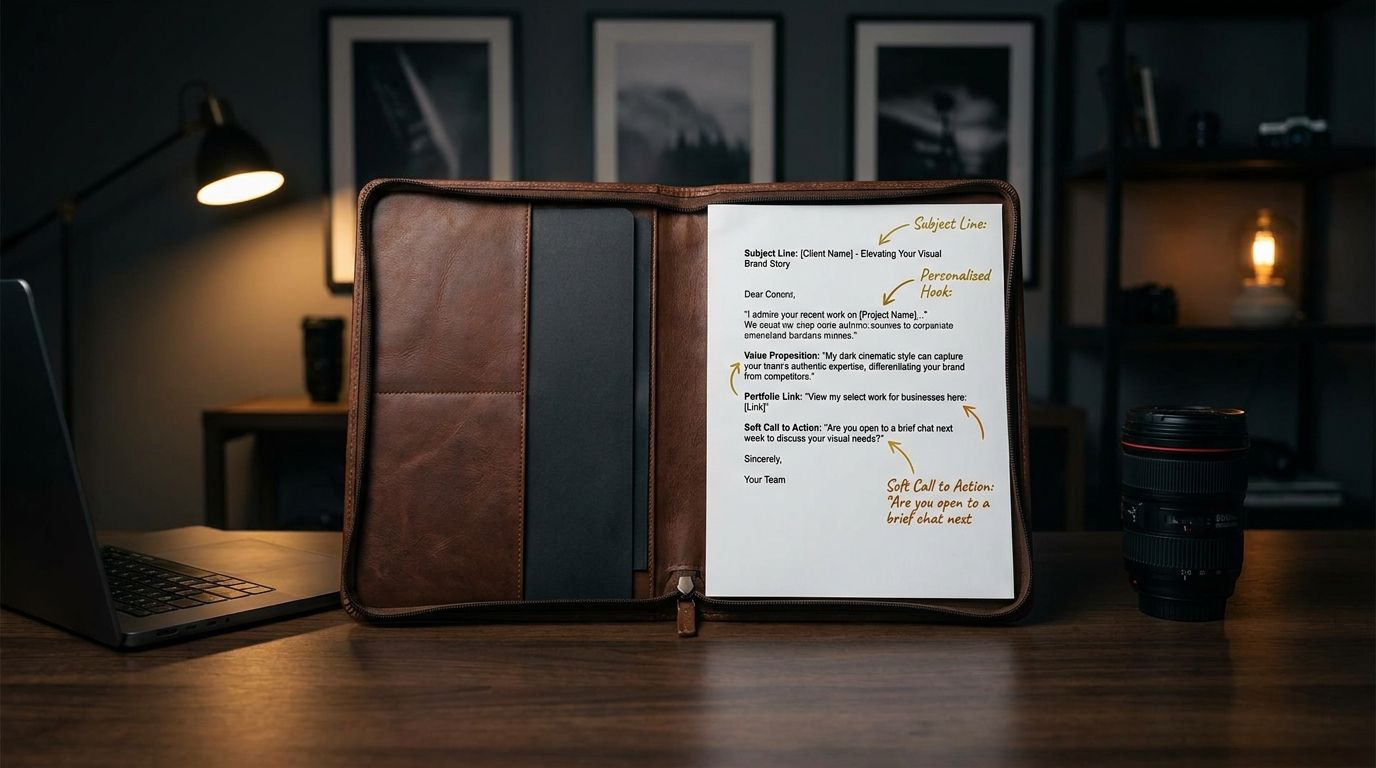
Sample Cold Email Pitch Template > > Subject: Quick question about [their brand/event] > > Hi [Name], > > I came across [specific thing — recent product launch, venue feature, Instagram post] and loved [specific detail]. > > I'm a [niche] photographer based in [city], and I work with [their type of business] to [specific outcome: capture product images that convert, document weddings without staged poses, etc.]. A few of my recent projects: [one portfolio link]. > > Would it be useful if I sent over a few ideas for your [next campaign / upcoming season]? > > Thanks, > [Your name] > > The #1 variable here is personalization. A generic template blast gets ignored. One sentence of real, specific research changes everything. Want more on this? Read our breakdown of how to write a photography pitch email.
Who to Pitch and Where to Find Them
Pitching works when you target the people whose business depends on photography. Here's who, by niche:
- Wedding: local wedding planners, florists, venues, bridal boutiques, hair/makeup artists. They refer clients constantly.
- Product/e-commerce: Etsy sellers, DTC startups, Shopify brands. Find them on Instagram and LinkedIn.
- Headshots: HR managers, recruitment agencies, co-working spaces, law firms, real estate brokerages.
- Real estate: active realtors on Zillow, local Facebook real estate groups, property management companies.
- Newborn: OB-GYN offices, doulas, baby boutiques, lactation consultants.
Research 10 ideal targets per week and personalize every pitch. A spreadsheet with name, business, contact, pitch date, follow-up date, and status is enough.
Following Up: The Non-Annoying Way
Most bookings come on the second or third touch — not the first email.
- Wait 5–7 business days before following up on an unanswered pitch.
- Add new value on each follow-up: a recent relevant shoot, a tip, a limited-time availability window.
- Three follow-ups maximum on cold pitches. Then close the loop and revisit in 3–6 months.
- Track every pitch in one place. You can't manage what you can't see.
Step 5: Convert Inquiries into Booked Shoots
You can have all the inbound and outbound in the world. If your inquiry-to-booking workflow leaks, you're refilling a bucket with a hole in it.
Here's the 5-step inquiry-to-booking flow that converts at the highest rate:
- Respond to every inquiry within 24 hours — ideally under 4 hours.
- Send a warm, personalized reply that references their specific event or project.
- Attach or link a pricing guide PDF that answers the most common questions.
- Invite them to a 15-minute discovery call to discuss their vision.
- Send a proposal with a clear "Book Now" button and online payment option. If they go quiet, send one friendly follow-up at day 5 and a final check-in at day 10.
Speed Is Your Biggest Competitive Advantage > > Lead response studies consistently show that responding within the first hour dramatically increases conversion vs. responding after 24 hours. When someone inquires, they're usually contacting 3–5 photographers in parallel. Being first to reply — and being warm and professional — wins more bookings than being the best photographer in the comparison.
Use a Contract for Every Shoot > > Every paid booking gets a signed contract covering deliverables, timeline, cancellation policy, payment schedule, and usage rights. No exceptions, even for friends. Requirements vary by location — consult local legal resources. Grab our photography contract template as a starting point.
What to Include in Your Pricing Guide
A pricing guide PDF closes the gap between curiosity and commitment. It also filters out people who can't afford you, which is exactly what you want.
- A starting investment statement, not a full price list. Position value before price.
- What's included: number of edited images, turnaround time, print rights, online gallery access.
- A short photographer story — two paragraphs, max. Build connection.
- A mini-FAQ answering the top 5 objections (timeline, deposit, what if it rains, can we add more time, do you travel).
- A clear next step: "Reply to schedule your 15-minute call" or "Click here to check your date."
Discovery Call Script Outline
A discovery call isn't a sales pitch. It's a conversation where you let them talk first.
- Open with: "Tell me about your [wedding/event/project] — what's your vision?"
- Listen for the emotional outcome they want, not just logistics. "We want the day to feel relaxed" matters more than the timeline.
- Share briefly how you work and what makes your approach different. Two minutes, max.
- Address pricing and concerns directly. Don't dodge.
- Close with a specific next step: "I'd love to hold your date. Here's how to lock it in."
Inquiry-to-Booking Workflow Checklist
- Respond to every inquiry within 24 hours (ideally under 4)
- Send a warm, personalized reply acknowledging their specific event or project
- Attach or link a PDF pricing guide
- Invite them to a 15-minute discovery call
- Send a proposal with a clear "Book Now" button and online payment
- Follow up once at day 5 if no response
- Send a final check-in at day 10 and close the loop
Step 6: Build a Referral and Repeat-Client Engine
Most photographers I know who book 40+ shoots per year aren't running aggressive marketing. They're running an aggressive referral system. Referrals convert 3–5x better than cold leads and require zero ad spend.
Here's the 5-step referral and repeat-client system:
- Deliver exceptional work and a smooth experience.
- Ask for a review and a referral at the moment of gallery delivery (peak emotion).
- Offer a referral incentive that feels genuinely valuable.
- Send a personal check-in 3 months after the shoot.
- Reach out to past clients every 90 days with something relevant.
Referral Ask Script > > Copy this and use it at gallery delivery: > > "I'm so glad you love your photos! Two quick favors: if you have 60 seconds, leaving a Google review would mean a lot — here's the link. And if you know anyone who'd benefit from working with me, I'd be so grateful for an introduction. As a thank-you, I offer [referral incentive] for anyone who books." > > Warm, specific, not pushy. That's the whole formula.
Referral Incentives That Work > > Skip the generic "10% off." Try a free 8x10 print, a complimentary mini-session, a free rush delivery on their next shoot, or 10 bonus edited images. The incentive should feel like a real gift to the referring client, not a transactional discount. Individual results vary — some photographers see 30%+ of their bookings come from referrals once the system is dialed in.
Quarterly Check-In System for Past Clients
Past clients are the most underused asset in photography. They already trust you. They already paid you once. Most photographers never contact them again.
- Set a reminder every 90 days to reach out to past clients with something specific and relevant.
- Reference their previous shoot: "I loved photographing your family last spring — I have fall mini-sessions opening up that would be perfect for an anniversary update."
- Don't only reach out when you need bookings. Send the occasional "thinking of you" email or share a printed image they'd love.
- Keep a simple CRM (a Google Sheet works) with names, shoot dates, anniversary dates, kids' ages, and last contact.
Vendor and Peer Referral Networks
Other vendors in your niche serve the same clients you want — and they refer constantly.
- Build relationships with non-competing vendors: planners, florists, venues, stylists, makeup artists.
- Refer clients to great vendors proactively. Reciprocity follows.
- Attend at least one local industry event per quarter to maintain the network.
- Set up formal exchanges: feature them on your blog, they feature you in their newsletter or vendor list.
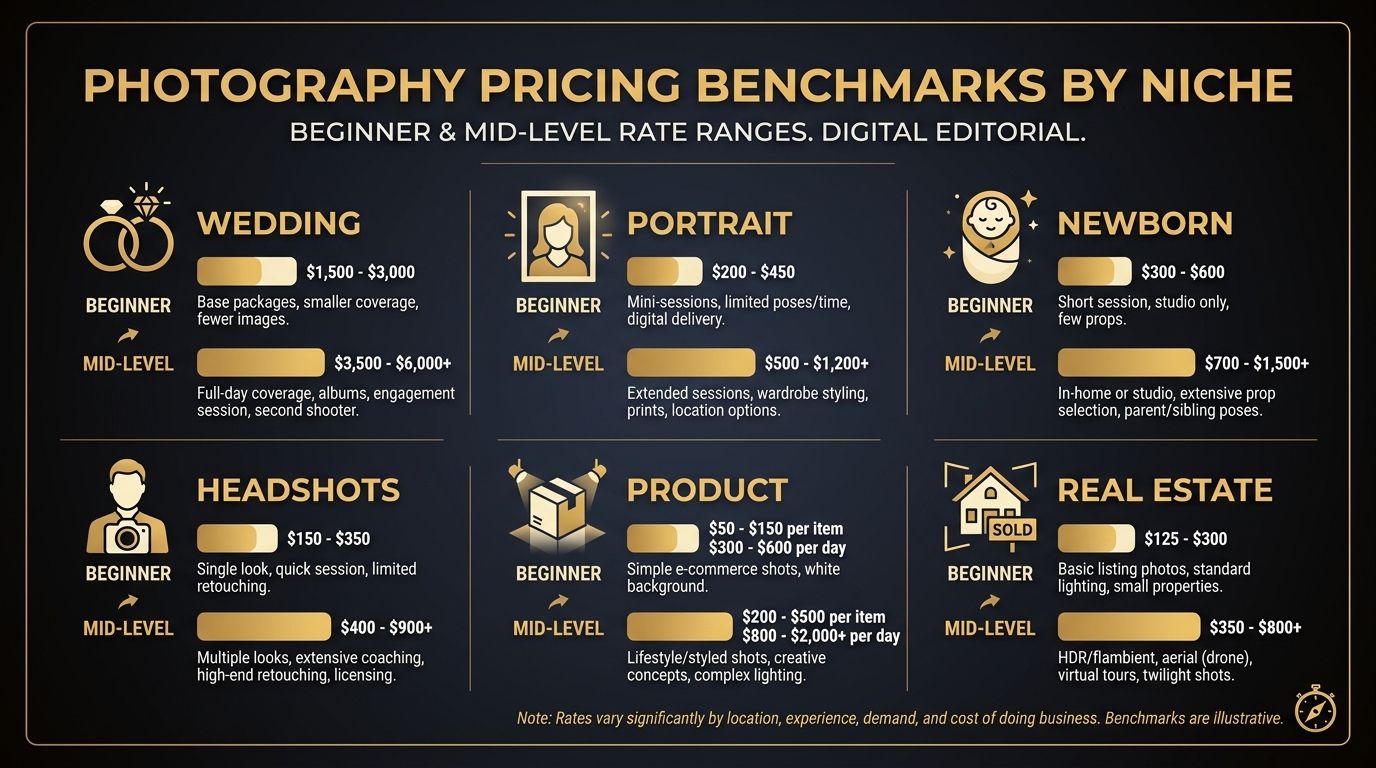
Photography Pricing Benchmarks by Niche
Let's break down the actual costs. These are approximate 2026 ranges drawn from PPA industry statistics and ASMP pricing guidance. Rates vary significantly by market, experience, and demand.
Photography Pricing Benchmarks by Niche (2026 Estimates)
| Niche | Beginner Range | Mid-Level Range | Notes |
|---|---|---|---|
| Wedding (full-day coverage) | $800–$1,800 | $2,500–$5,500 | Highest variance by market; major metros 2–3x rural |
| Portrait (1–2 hr session) | $150–$400 | $500–$1,200 | Often sold with print packages |
| Newborn (in-home session) | $300–$650 | $800–$2,000 | Often includes printed album or wall art |
| Headshots (per person/half-day) | $150–$350 / person | $500–$1,500 / half-day | Corporate group rates higher |
| Product/E-commerce (per image or day) | $25–$75 / image | $1,200–$3,500 / day | Usage rights affect price |
| Real Estate (per property) | $150–$300 | $350–$700 | Add-ons: drone, twilight, virtual staging |
Source: estimates derived from PPA Industry Statistics and ASMP Pricing & Negotiating guidance. Rates vary by geography and market conditions.
Do Not Undercut to Win Clients > > Competing on price alone attracts price-sensitive clients who don't refer and don't rebook. You'll work twice as hard for half the income. Price for the outcome — memories, professional brand images, conversion-ready product shots — not just your time. Research your local market, pick a rate that covers your costs plus margin, and plan an annual price review.
How to Set Your Starting Rates
- Research 5–10 established photographers in your niche and city. Browse their websites and directory listings.
- Calculate your real cost of doing business first: gear depreciation, software (Lightroom, Photoshop, gallery hosting), insurance, travel, editing time, taxes.
- Set a rate that covers costs plus a profit margin — even at the beginner level. If your CODB is $200 per shoot and you charge $250, you're working for $50. That's not a business.
- Raise rates after every 5–10 bookings or once your inquiry volume exceeds your capacity.
- When you transition from styled/free to paid, set the first paid rate as a "founding client" or "introductory" price — not your long-term floor.
For a deeper breakdown, see our guide on how to price your photography services.
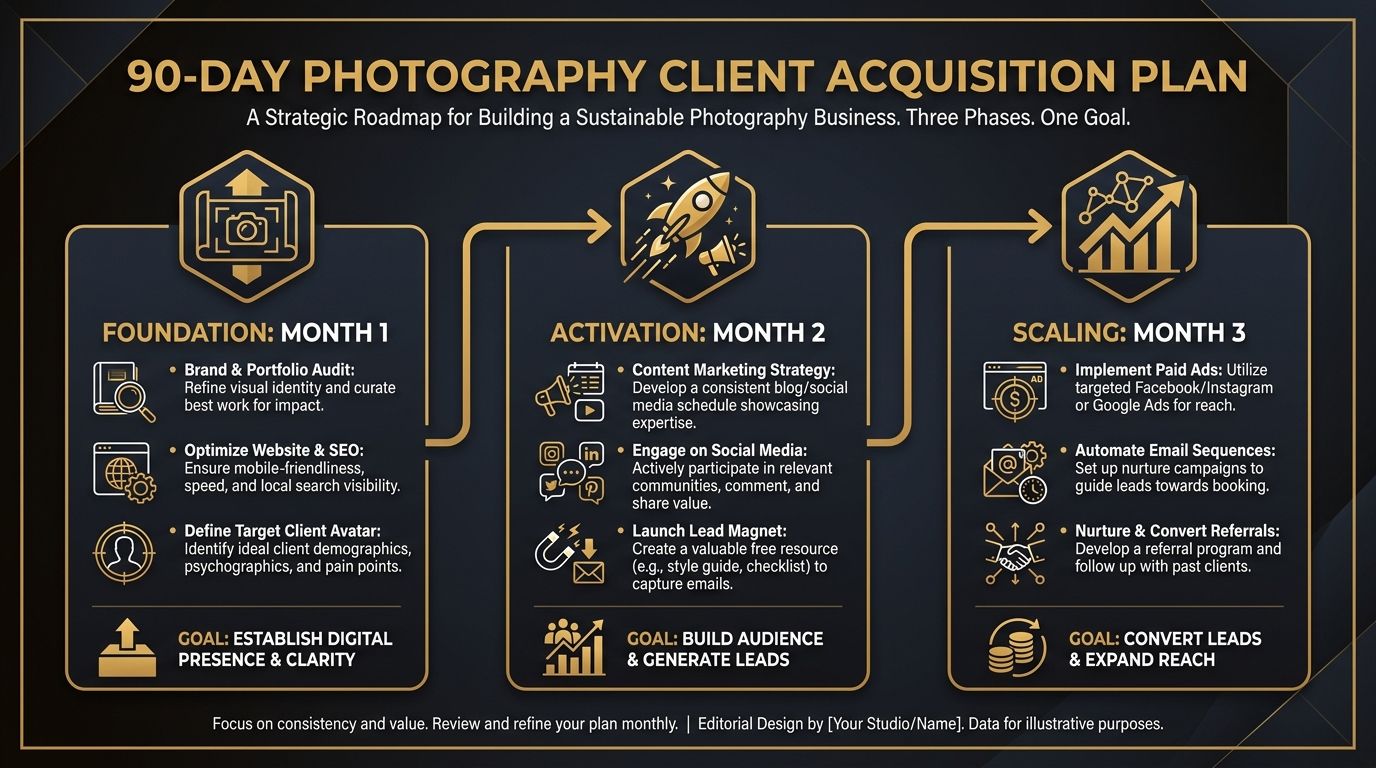
Your 90-Day Photography Client Acquisition Plan
Most photographers fail because they don't know what to do this week. So here's exactly what to do, in three phases.
90-Day Photography Client Acquisition Plan
| Phase | Days | Weekly Priorities |
|---|---|---|
| **Phase 1: Foundation** | Days 1–30 | Lock in your niche. Complete 3–5 styled shoots. Launch a fast, SEO-ready website. Claim and fully optimize your Google Business Profile. Send warm outreach to 20 people in your existing network. |
| **Phase 2: Activation** | Days 31–60 | Send 10 personalized pitches per week. Post 3x per week on your primary social channel. Collect your first 3–5 Google reviews. Respond to every inquiry within 24 hours. Reach out to 3 local photographers about second-shooting. |
| **Phase 3: Scaling** | Days 61–90 | Refine your inquiry-to-booking workflow based on what's converting. Launch a referral ask after every shoot. Add Pinterest (or a second channel). Audit your website traffic and top landing pages. Raise rates if demand exceeds capacity. |
Track Your Numbers > > Build a simple weekly scorecard with four metrics: pitches sent, inquiries received, discovery calls booked, shoots booked. If pitches are low → outreach problem. If inquiries are low → portfolio or SEO problem. If calls are low → response speed problem. If shoots are low → pricing or closing problem. A Google Sheet is plenty.
Niche-Specific Tactics at a Glance
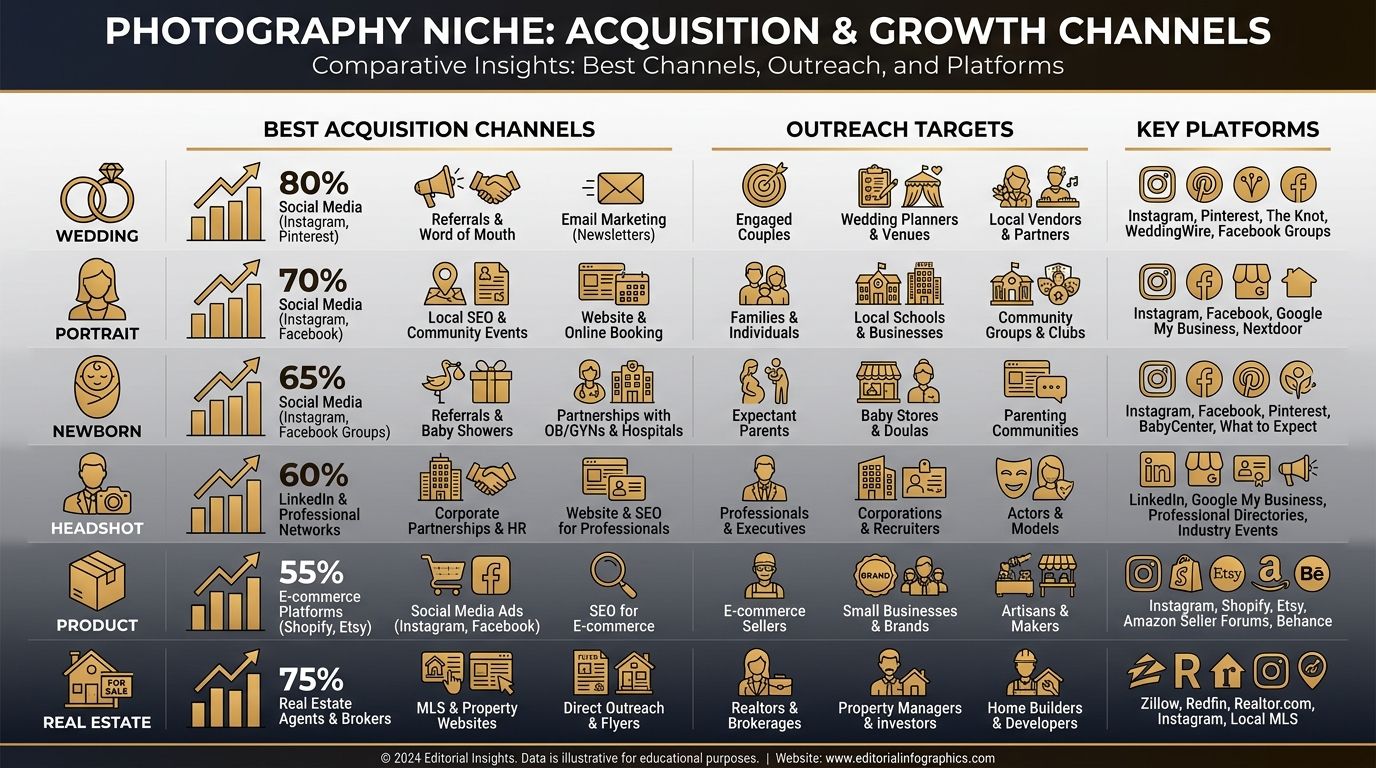
Photography Niche Client Acquisition Comparison
| Niche | Best Acquisition Channel | Best Outreach Target | Key Platform | Quick Win |
|---|---|---|---|---|
| Wedding | Vendor referrals + directories | Wedding planners, venues, florists | Instagram + The Knot | Second-shoot for an established photographer |
| Portrait/Family | Community + Instagram | Parents in local Facebook groups | Instagram + Facebook | Run a seasonal mini-session day |
| Newborn | Local partnerships | OB-GYNs, doulas, baby boutiques | Facebook groups | Partner with a birth photographer |
| Headshots | LinkedIn + cold email | HR managers, recruiters, co-working spaces | Host a free headshot event at a co-working space | |
| Product/E-commerce | Direct email pitch | Etsy sellers, DTC brands | Instagram + LinkedIn | Pitch 10 brands per week with sample shots |
| Real Estate | Agent referrals | Active Zillow realtors | Facebook real estate groups | Offer a free listing shoot to one promising agent |
Frequently Asked Questions About Getting Photography Clients
How do beginner photographers get their first client?
Start by activating your warm network — email or DM 20 people you already know and announce your services at an introductory rate. Complete 3–5 styled or discounted shoots to build your portfolio, then immediately begin cold pitching 10 ideal clients per week. Most beginners book their first paying client within 30–60 days of consistent outreach.
How much should a beginner photographer charge?
Rates vary by niche and market, but beginner portrait photographers typically charge $150–$400 per session, while beginner wedding photographers often range from $800–$1,800 for partial or full-day coverage. Calculate your cost of doing business first, then price above that floor. Raise your rates every 5–10 bookings as demand grows. Reference PPA and ASMP benchmarks for your specific niche.
How do I get photography clients without social media?
Social media is helpful but not required. Focus on Google Business Profile (free and highly effective for local search), word-of-mouth referrals, direct email pitching to local businesses, in-person networking at industry events, and listing on niche directories like The Knot or Thumbtack. Many successful photographers book a full calendar purely through referrals and local SEO.
Is it worth advertising on The Knot or WeddingWire?
Paid listings on The Knot and WeddingWire can deliver leads, but ROI varies significantly by market, your profile quality, and the tier of listing. Before committing to a paid annual subscription, try a lower-tier listing, track every inquiry it generates, and calculate your cost per booked client. In saturated markets, the same budget often performs better invested in local SEO and Google Business Profile.
How do photographers get consistent monthly bookings?
Consistency comes from systems, not luck. The photographers who book consistently send outreach every single week (10+ pitches), post on social media on a schedule, follow up on every inquiry at least twice, send quarterly check-ins to past clients, and run an active referral program. Track your pipeline numbers weekly so you can spot and fix weak points.
How long does it take to build a full-time photography business?
Most photographers reach part-time income (replacing a side income or covering business expenses) within 6–12 months of consistent effort. Building a fully booked, full-time photography business typically takes 1–3 years, depending on niche, local market, marketing consistency, and how quickly you raise your rates. Individual results vary significantly based on effort and market conditions.
What is the best platform to find photography clients?
There's no single best platform — it depends on your niche. Wedding photographers see strong results from The Knot, Google Business Profile, and Instagram. Product photographers often find clients via LinkedIn and direct email pitching. Portrait photographers typically do well with Instagram, Facebook community groups, and Google local search. Start with one or two channels, master them for 90 days, then expand.
How do I turn a one-time client into a repeat client?
Deliver an exceptional experience and a seamless gallery. Ask for a review and referral at delivery. Add them to a simple email list and send a personal check-in every 90 days with a relevant offer (seasonal mini-sessions, anniversary portraits, updated headshots). Personal, timely follow-up is the most underused repeat-client strategy in photography.
Sources
- Professional Photographers of America — Industry Statistics
- ASMP — Pricing & Negotiating Photography
- Google Developers — Largest Contentful Paint (LCP)
- Google — Create a Business Profile on Google
- PhotoShelter — Photographer Index & Industry Reports
- DPReview — Digital Photography Review
- PetaPixel — Photography Business
- The Knot Pro — Resources for Wedding Vendors
- Pinterest Business — Success Stories
- Google Search Central — FAQ Structured Data