How much does it really cost to start a photography business in 2026?
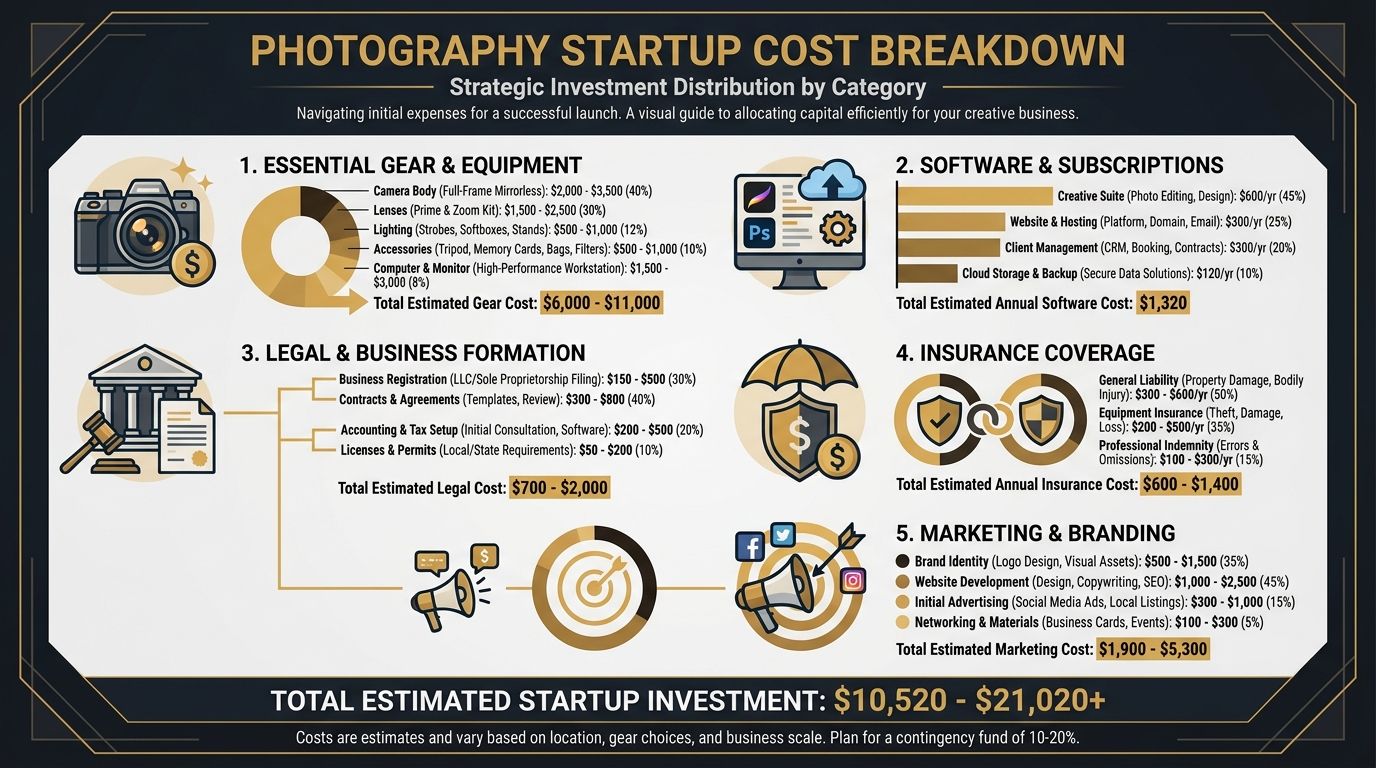
Quick answer: Starting a photography business in 2026 typically costs between $2,000 and $20,000 depending on your niche and how fully equipped you want to be from day one. A lean home-based setup — one camera body, a versatile lens, basic editing software, an LLC, and liability insurance — can launch for as little as $2,000 to $5,000, while a full professional studio setup with backup gear, premium software, and a marketing budget runs $13,000 to $20,000 or more. The right starting point depends on your niche, your existing gear, and how quickly you need to recoup costs.
Plan your photography business budget with a full 2026 cost breakdown — gear, software, LLC, insurance, marketing — across lean, standard, and premium tiers.
Key Takeaways
- Lean startups can launch for $2,000–$5,000; standard setups cost $6,000–$12,000; premium setups run $13,000–$20,000+.
- Separate your one-time startup costs from recurring monthly expenses before building your budget.
- Niche matters: wedding photography requires more gear and insurance than real estate or portrait work.
- Buying used gear or renting equipment can cut startup costs by 40–60%.
- LLC registration fees vary widely by state — always check your state's current filing fee.
- Most photographers reach break-even within one to three years depending on session volume and pricing.
- Many startup costs — gear, software, home office, mileage — are tax-deductible, lowering your effective outlay.
Photography Business Startup Costs at a Glance
Here's the reality: most "how much does it cost to start a photography business" guides hand you one inflated number and call it a day. That's useless when you're trying to decide between a side hustle launch and going full-time. So let's break down the actual costs by category first, then by tier.
Core Photography Business Startup Cost Categories
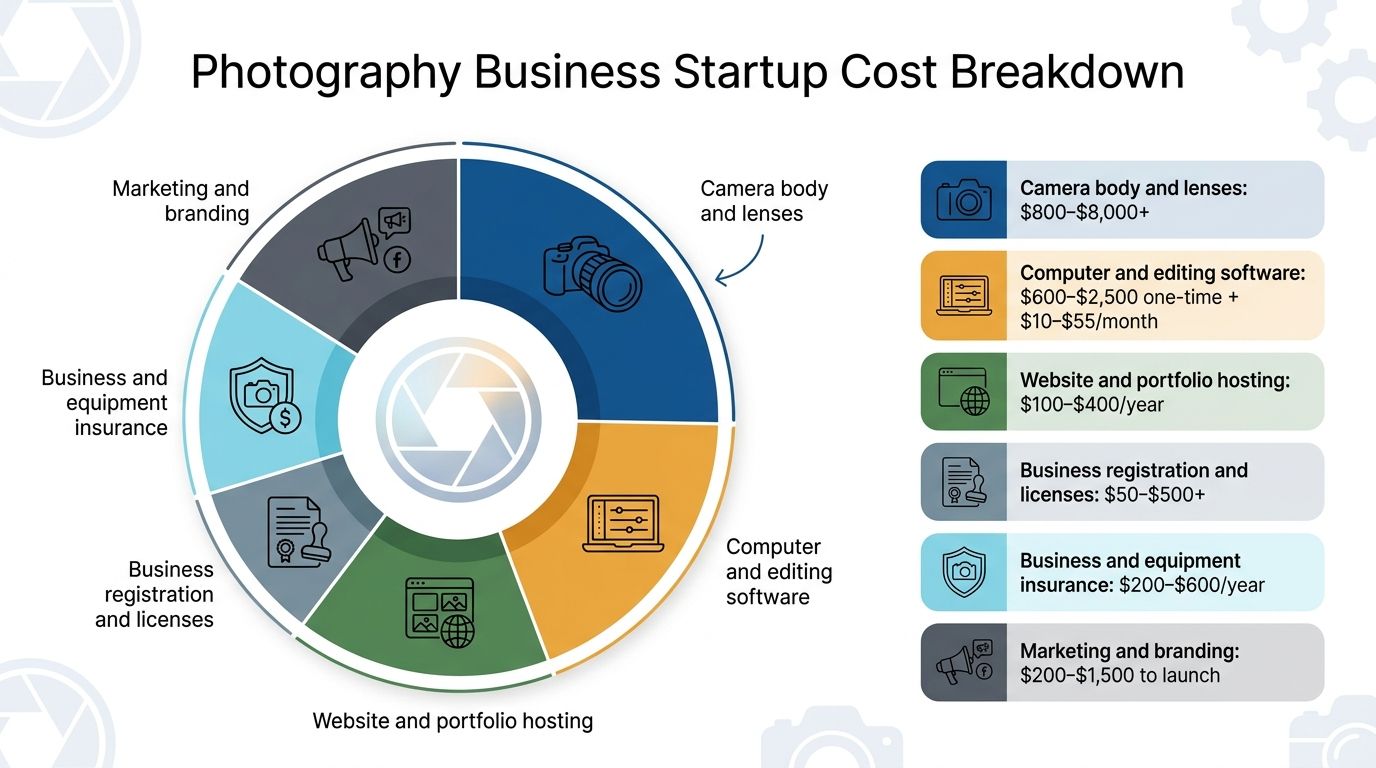
- Camera body and lenses: $800–$8,000+
- Computer and editing software: $600–$2,500 one-time + roughly $10–$55/month for a subscription like the Adobe Photography Plan (verify current pricing)
- Website and portfolio hosting: $100–$400/year
- Business registration and licenses: $50–$500+ (varies by state — see the SBA business registration guide)
- Business and equipment insurance: $200–$600/year (varies by coverage and niche)
- Marketing and branding: $200–$1,500 to launch
💡 Quick Cost Range: Lean setups run $2,000–$5,000, standard setups run $6,000–$12,000, and premium setups run $13,000–$20,000+. Jump to the full tier table below to see exactly what each level buys you.
These ranges are wide on purpose. A part-time portrait photographer in a small market and a full-time wedding photographer in a major metro are running two completely different businesses, even though Google lumps them under the same query.
Lean, Standard, and Premium Budget Tiers
I've coached photographers who launched on $2,500 and built six-figure businesses within three years. I've also watched people drop $18,000 on gear before booking their first paid client. Neither path is automatically wrong — but you need to know which one fits your situation.
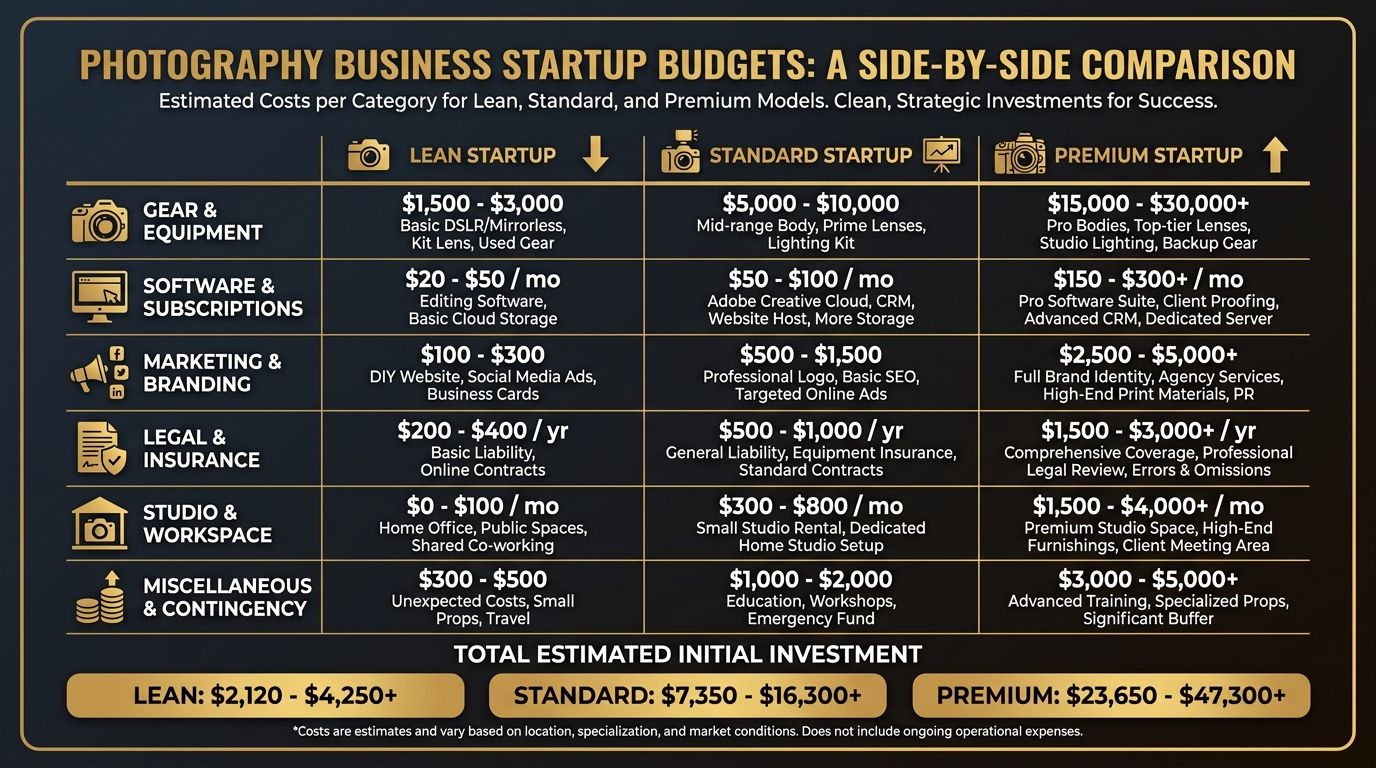
| Cost Category | Lean ($2,000–$5,000) | Standard ($6,000–$12,000) | Premium ($13,000–$20,000+) |
|---|---|---|---|
| Camera and lenses | $800–$2,000 (used body + 1 lens) | $2,500–$5,500 (new body + 2 lenses) | $6,000–$10,000+ (2 bodies + 3 lenses) |
| Lighting and accessories | $100–$300 | $400–$1,000 | $1,200–$3,000 |
| Computer and storage | $0–$800 (use existing) | $1,000–$1,800 | $2,000–$3,500 |
| Editing software (1 yr) | $120–$300 | $300–$500 | $500–$800 |
| Website and hosting | $150–$300 | $300–$500 | $500–$1,000 |
| Business registration / LLC | $50–$300 | $150–$500 | $300–$800 |
| Insurance (1 yr) | $200–$400 | $400–$700 | $700–$1,500 |
| Marketing and branding | $200–$500 | $700–$1,500 | $1,800–$3,500 |
| **Total estimate** | **$2,000–$5,000** | **$6,000–$12,000** | **$13,000–$20,000+** |
All figures are estimates and vary by location, market, and existing gear.
💡 Which tier is right for you? Lean = part-time or side hustle with some gear already in hand. Standard = full-time launch focused on one niche. Premium = multi-niche or studio-based pro who needs to look the part on day one.
Who Should Start at the Lean Tier?
- Part-time or side-hustle photographers who already own a capable camera
- Beginners building a portfolio before committing to full-time work
- Niches with lower gear requirements like portrait or newborn photography
- Anyone who'd rather prove demand before sinking $10K into gear
Lean does not mean cutting corners on legal setup or insurance. Skip the $3,000 lens. Don't skip the liability policy.
When the Standard or Premium Tier Makes Sense
- Full-time launch where photography income must replace a salary within 12–18 months
- Niches that demand specialized or backup gear — wedding, commercial, real estate
- Photographers chasing premium clients who expect a polished brand and studio
- Markets where competition is fierce and you can't afford to look amateur
A bigger budget is an investment decision tied to projected revenue, not ego. If you can't connect a $4,000 lens purchase to specific bookings it will help you close, wait.
Essential One-Time Startup Costs
Let's walk through every must-have line item. Each one has a job. If you can't explain why you're spending the money, you probably shouldn't be.
💡 Tip: Buy the camera body last. Glass holds its value better than bodies. Picking your lenses first usually leads to smarter long-term spending, because you can carry those lenses across multiple body upgrades.
Camera Body and Lenses
- Entry-level mirrorless or DSLR body: roughly $500–$1,500 new, significantly less used
- Mid-range professional body: roughly $1,500–$3,500 — cross-check current MSRP and reviews on DPReview before buying
- Lens recommendation: one versatile zoom (24–70mm equivalent) or two primes covers most niches at launch
- Additional lens costs: $300–$2,000+ per lens depending on aperture and focal length
- Memory cards, batteries, and a camera bag: $150–$400 total
I've tested this personally across Canon, Sony, and Nikon ecosystems. For 90% of new photographers, a used mid-range mirrorless body and one fast zoom will outshoot what your skills currently demand. Don't buy gear your portfolio can't justify yet.
Computer, Storage, and Editing Software
- Laptop or desktop with adequate RAM and a color-accurate display: $600–$2,000 if you don't already own one
- External hard drives for backup: $80–$200 for a two-drive redundant setup (follow the 3-2-1 backup rule: three copies, two media types, one offsite)
- Adobe Photography Plan (Lightroom + Photoshop): verify the current monthly rate on Adobe's official page — it has changed several times in recent years
- Lower-cost alternatives: Capture One, Luminar Neo, or Darktable (free open source)
- Client gallery delivery (Pic-Time, ShootProof, Pixieset): typically $10–$30/month — a recurring cost, not a one-time spend
A failed hard drive that loses a wedding gallery will end your business. Spend the $150 on backup drives before you spend $1,500 on a fancier lens.
Website and Portfolio
- Domain registration: $10–$20/year
- Website hosting and builder (Squarespace, Wix, Pixpa, WordPress): about $150–$300/year for photography-friendly plans
- Booking or portfolio plug-ins: $50–$150/year
- Brand identity (logo, color palette): $0 DIY in Canva up to $500+ for a freelance designer
You don't need a custom-coded site. You need a clean portfolio with your best 20 images, clear pricing or a "request quote" form, and a contact button that actually works on mobile.
Business Registration and Licenses
⚠️ LLC fees vary by state. State filing fees range from under $50 to over $500. Check your state's Secretary of State website or the SBA's register-your-business guide for current figures. Anyone quoting a single national LLC cost is guessing.
- Sole proprietorship: often free to operate under your own name; a DBA ("doing business as") filing usually costs $10–$50
- LLC formation: state filing fees vary — check your state's Secretary of State page
- Registered agent: free if you act as your own; $100–$300/year for a third-party service
- EIN (Employer Identification Number): free directly from the IRS
- Local business license: $0–$100+ depending on city and county
- Sales tax permit: typically free; required in most states if you sell taxable goods or services
Business and Equipment Insurance
- General liability: protects against client injury or property damage claims — get current quotes from Hiscox or Thimble before assuming a price
- Equipment insurance (inland marine): covers gear theft or damage; often bundled or available as a rider
- Professional indemnity (errors and omissions): more important for commercial photographers; premiums vary by niche and limit
- Wedding photographers usually need higher liability limits than portrait photographers — many venues require $1M minimums
- Professional Photographers of America (PPA) membership includes some equipment coverage and is worth pricing against standalone policies
Skipping insurance on a wedding day is the single fastest way to lose your house. I've seen it happen. Get a policy before you take a deposit.
Ongoing Monthly and Annual Costs
This is the part most startup guides skip, and it's where new photographers get blindsided. Your gear is paid for. Your recurring costs are not.
| Expense | Estimated Cost | Frequency |
|---|---|---|
| Editing software (Adobe Photography Plan) | Verify current rate on [Adobe.com](https://www.adobe.com/creativecloud/photography/plans.html) | Monthly |
| Client gallery platform (Pixieset, Pic-Time, ShootProof) | $10–$30 | Monthly |
| Website hosting (Squarespace, Wix, etc.) | $15–$30 | Monthly |
| CRM / booking (HoneyBook, Dubsado, 17hats) | $15–$50 | Monthly |
| Cloud backup (Backblaze, Google One) | $3–$10 | Monthly |
| Accounting (QuickBooks SE, FreshBooks, Wave) | $0–$20 | Monthly |
| Business insurance (annualized) | $200–$600 | Annual |
| Professional association dues (e.g., PPA) | $25 | Monthly avg |
| Marketing and advertising | $50–$300+ | Monthly |
All estimates vary by plan, location, and provider.
⚠️ Monthly burn rate matters. Recurring costs continue in slow months. Add up your minimum monthly overhead, then use that as your floor when setting how many sessions you have to book each month to stay solvent.
Software Subscriptions to Budget For
- Editing: Adobe Photography Plan or a one-time-purchase alternative like Affinity Photo
- CRM and contracts: HoneyBook, Dubsado, or 17hats — roughly $15–$50/month
- Client gallery delivery: Pixieset, Pic-Time, or ShootProof — $10–$30/month
- Cloud backup: Backblaze, Google One, or Dropbox — $3–$10/month for a starter tier
- Accounting: QuickBooks Self-Employed, FreshBooks, or Wave (free) — $0–$20/month
Stack these up and you're often at $80–$150/month before you've booked a single client. Plan for it.
Marketing and Advertising Expenses
- Organic social media: time, not money
- Google Ads or Meta Ads: even $50–$150/month can generate leads in less competitive local markets
- Styled shoots and model fees for portfolio building: $50–$300 per shoot, occasional
- Print marketing (business cards, brochures): $50–$150 to start, low ongoing cost
If you're new, spend on portfolio shoots before you spend on ads. Ads send people to your site. If your site looks thin, you've wasted the click.
Startup Costs by Photography Niche
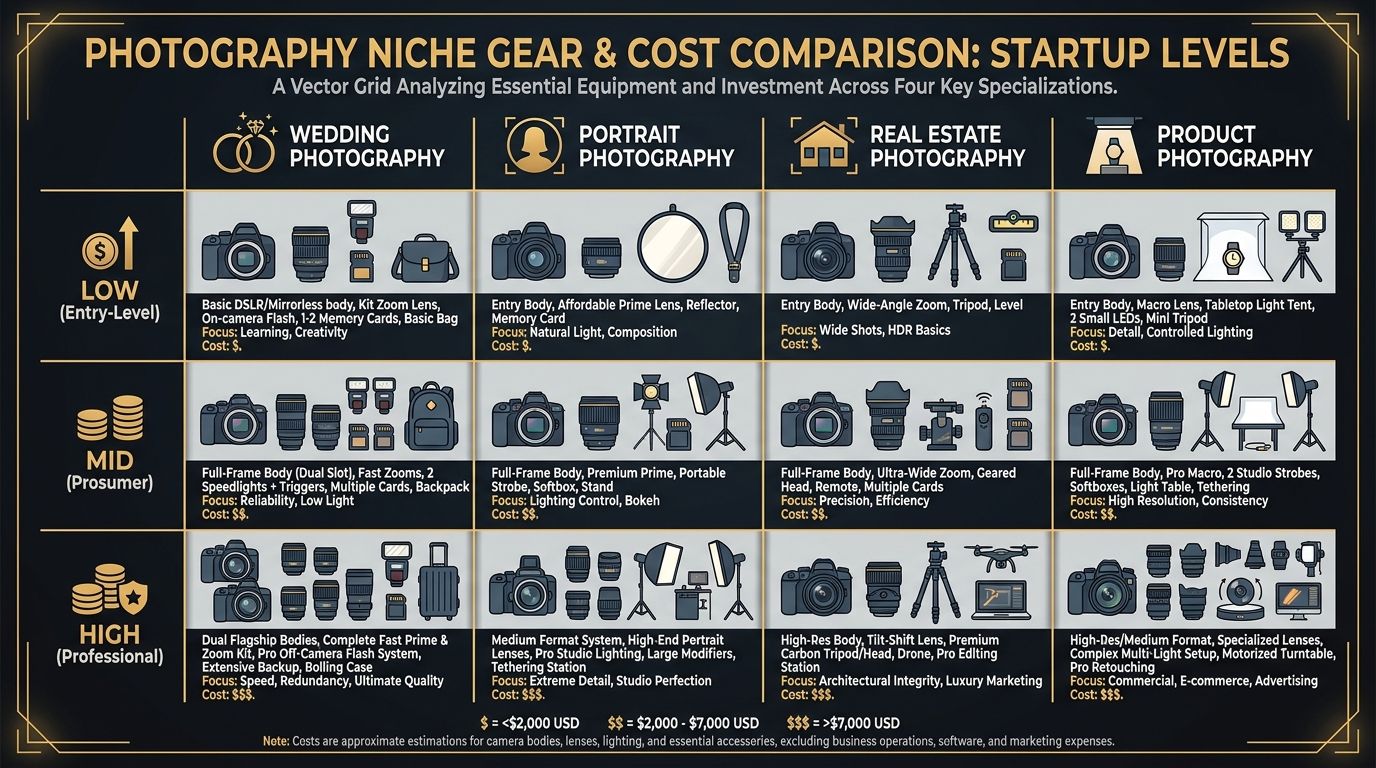
Niche choice changes your gear list more than any other decision. A wedding photographer and a product photographer need almost nothing in common beyond a camera body.
| Niche | Minimum Gear Cost | Recommended Extras | Insurance Notes | Typical Startup Range |
|---|---|---|---|---|
| Wedding | $3,000–$6,000 (2 bodies, 2–3 lenses, flash) | Backup memory cards, extra batteries, second shooter | Higher liability limits often required by venues | $4,000–$12,000+ |
| Portrait | $1,200–$3,000 (1 body, 1–2 lenses) | Reflectors, basic backdrop, posing stool | Standard general liability is usually sufficient | $2,000–$6,000 |
| Real Estate | $1,500–$3,500 (1 body, wide lens, tripod) | Drone (FAA Part 107 required), flash, HDR software | Drone coverage may need a separate policy | $2,500–$7,000 |
| Product | $1,000–$2,500 (1 body, macro/50mm, lights) | Lightbox, calibrated monitor, tethering cable | Lower liability needs; equipment coverage matters more | $1,500–$5,000 |
💡 Niche affects more than gear. Wedding photographers need two camera bodies as backup — a single failure can ruin an irreplaceable event. Real estate photographers prioritize a wide-angle lens and often a drone over lighting gear. Match the spend to the job.
Wedding Photography
- Two camera bodies (primary and backup) — doubles your body budget
- Off-camera flash, diffusers, and light stands add $200–$800
- Higher liability insurance limits expected by most venues — verify with Hiscox or PPA
- Second shooter is a per-job expense, not a startup cost
- Startup range: $4,000–$12,000+ depending on existing gear
Wedding clients are paying you to deliver an event that cannot be reshot. The gear redundancy isn't optional.
Portrait Photography
- The most accessible niche for lean starters: one body and one or two primes cover most scenarios
- Continuous lighting or speedlights add $200–$600 for studio-style work
- Optional backdrop and posing furniture: $100–$400
- Startup range: $2,000–$6,000 for a home or on-location setup
Family, senior, and headshot photographers can launch on the lean tier and reinvest into a dedicated studio later.
Real Estate Photography
- Wide-angle lens (full-frame equivalent 16–24mm): $400–$1,200 — non-negotiable
- Tripod and remote shutter: $80–$200
- Drone for aerials: $400–$1,500+, plus FAA Part 107 certification required for commercial drone work in the US
- HDR or flash-blending workflow; Lightroom or Photomatix software
- Startup range: $2,500–$7,000 including drone
Product Photography
- Lightbox or softbox lighting setup: $100–$500
- Macro or standard 50mm lens: $150–$600
- Clean backdrop materials and a stable surface: $50–$200
- Calibrated monitor or colorimeter: $100–$300 — color accuracy makes or breaks e-commerce work
- Startup range: $1,500–$5,000 for a home studio setup
How to Cut Startup Costs Without Sacrificing Quality
I wasted around $2,000 on gear in my first year that I either didn't need or could've rented for a fraction of the cost. Here's how to avoid that.
The cheapest ways to start a photography business:
- Use the camera you already own and upgrade only when paid work demands it
- Buy used gear from reputable platforms like MPB or KEH
- Rent specialty lenses through LensRentals instead of buying
- Use free editing software (Darktable) and free accounting (Wave) for year one
- Register as a sole proprietor before upgrading to an LLC once revenue justifies it
- Build your portfolio with styled shoots and trade-for-portfolio sessions before paying for ads
| Option | Example Cost (mid-range body) | Best For | Risk Level |
|---|---|---|---|
| Buy New | $2,000–$3,500 | Long-term daily use, warranty matters | Low (financial commitment is the risk) |
| Buy Used (MPB, KEH) | $1,200–$2,400 | 30–50% savings, still reliable | Low–Medium (check return policy) |
| Rent (LensRentals) | $50–$150/day | Specialty gear used <10x/year | Very low |
💡 Renting before buying. Rent a lens for a shoot or two before you commit to buying it. LensRentals and similar platforms let you test expensive glass on a real job — far smarter than reading a review and gambling $1,800.
Buy Used or Refurbished Gear
- Reputable used marketplaces: MPB, KEH Camera, B&H Used, Adorama Used
- Typical savings vs. new: 30–50% on bodies, 20–40% on lenses
- Look for "Excellent" or "Like New" ratings with a return policy
- Manufacturer-refurbished gear ships with a warranty and is the lowest-risk used option
Rent Equipment for Specialty Shoots
- Renting makes sense for gear you'd use fewer than 10 times per year
- Common examples: tilt-shift lenses for architecture, 70–200mm telephotos for occasional sports, studio strobes for a styled session
- LensRentals, BorrowLenses, and local camera clubs are the typical sources
- Bake the rental cost into your per-job pricing so it's cost-neutral
Use Free or Lower-Cost Software Alternatives
- Darktable and RawTherapee: free open-source Lightroom alternatives — there's a learning curve, but they're capable
- Wave Accounting: free invoicing and bookkeeping for freelancers
- Google Workspace: free tier covers basic business email and storage
- Canva Free: handles logo, social graphics, and basic brand assets at launch
This stack alone can save you $400–$600 in your first year.
How Long Until You Break Even?
Most startup guides skip this entirely. They tell you what to spend and then leave you guessing when you'll see it back. Let's fix that.
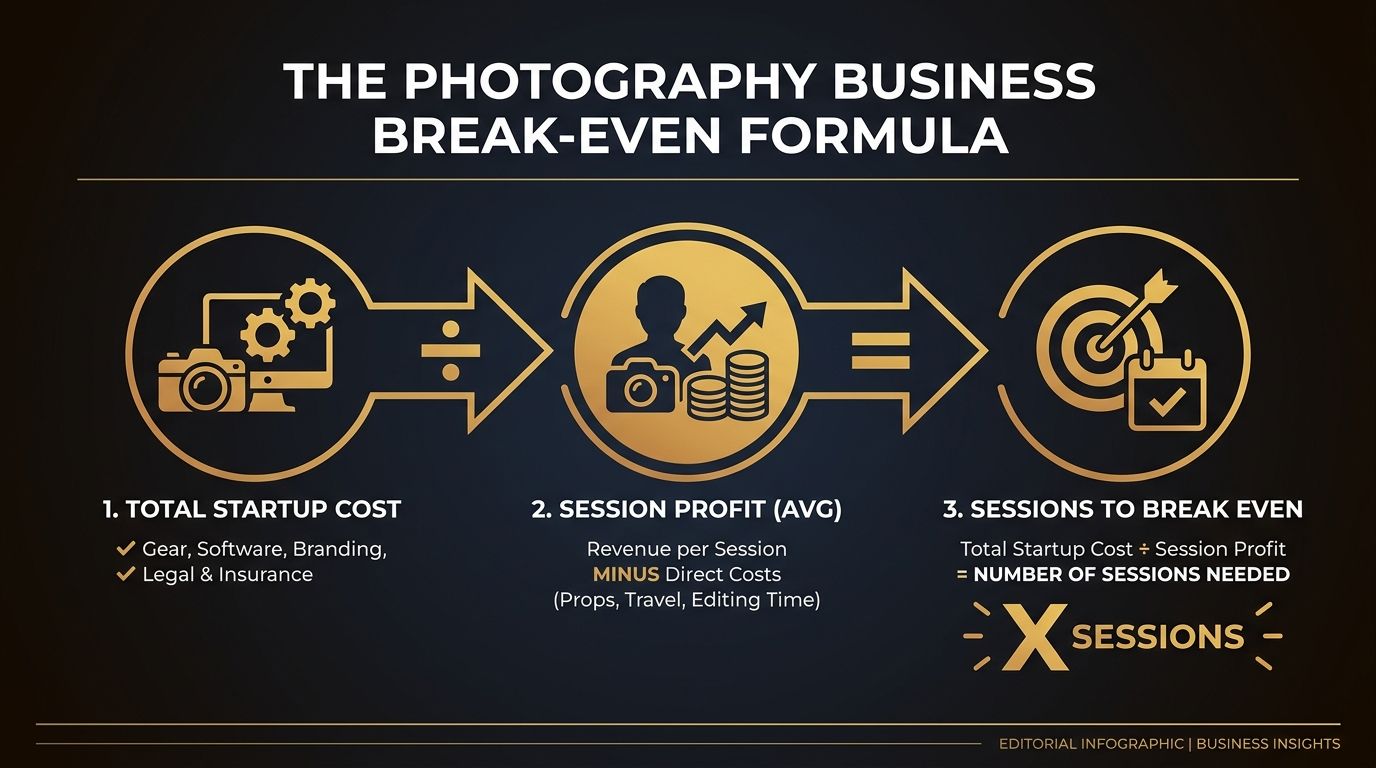
How long does it take a photography business to break even? Divide your total startup cost by the net profit you expect per session. The result is the number of sessions you need to book to recover your initial investment. Most photographers break even within 6 to 18 months at moderate booking volume, though aggressive lean starters can hit it in under 6 months and underpriced sessions can stretch it past two years.
| Startup Cost | Average Session Profit | Sessions Per Month | Estimated Break-Even |
|---|---|---|---|
| $3,000 (lean) | $150 | 2 | ~10 months |
| $3,000 (lean) | $150 | 5 | ~4 months |
| $8,000 (standard) | $250 | 2 | ~16 months |
| $8,000 (standard) | $250 | 5 | ~7 months |
| $15,000 (premium) | $400 | 2 | ~19 months |
| $15,000 (premium) | $400 | 5 | ~8 months |
All figures are illustrative. Session profit varies widely by niche, market, and pricing. Reference the [PPA Benchmark Survey](https://www.ppa.com/resources/industry-survey) for industry pricing data.
💡 Price to cover overhead first. Add up your monthly recurring costs, divide by the number of sessions you realistically expect to book each month, and that floor becomes the minimum charge per session before profit. If your monthly burn is $400 and you book 4 sessions, your first $100 of each session is already spoken for.
⚠️ Break-even is not the goal — profitability is. Breaking even just means you've recovered costs. You also need to pay yourself. Build a pricing model that funds your time, your taxes, and reinvestment, not just your overhead.
The Break-Even Formula Explained
- Formula: Total Startup Cost ÷ Net Profit Per Session = Sessions Needed to Break Even
- Example (illustrative only): $6,000 startup ÷ $200 net profit per session = 30 sessions
- At 3 sessions per month, that's roughly 10 months to break even
- Treat this as a planning tool. Real results swing based on local rates, overhead, and how fast referrals kick in
Factors That Accelerate or Delay Break-Even
- Niche and average session value — wedding photographers typically charge multiples of what portrait photographers do per booking
- Speed of portfolio building and word-of-mouth referrals
- Whether you already own usable gear (lowers effective startup cost)
- Local market saturation and pricing pressure
- Part-time vs. full-time commitment, which directly affects monthly booking volume
Tax Write-Offs That Lower Your Effective Startup Cost
Here's something most new photographers don't realize: your effective startup cost is lower than your sticker price because much of it is tax-deductible. That $8,000 standard tier might actually cost you closer to $6,000 after deductions in your first profitable year.
Commonly Deductible Photography Business Expenses
- Camera bodies, lenses, and accessories (Section 179 or depreciation)
- Editing software subscriptions
- Computer and monitor used for business
- Home office (dedicated space only — see IRS home office guidelines)
- Vehicle mileage for client shoots and vendor meetings
- Website hosting and domain fees
- Business insurance premiums
- Professional association dues (PPA, ASMP, etc.)
- Marketing and advertising costs
- Professional development courses and workshops
⚠️ Always consult a tax professional. Tax rules change every year and vary by state and situation. The categories above are general guidance based on current IRS resources. Before filing, talk to a licensed CPA or tax advisor who works with self-employed creatives.
Section 179 and Bonus Depreciation
- Section 179 lets businesses deduct the full purchase price of qualifying equipment in the year of purchase rather than depreciating it over multiple years
- Camera bodies, lenses, computers, and lighting equipment typically qualify
- Annual deduction limits apply and change — verify the current limit with IRS guidance before counting on a specific number
- Bonus depreciation may allow additional first-year deductions; rules have shifted in recent years
Home Studio and Vehicle Deductions
- The home office deduction applies only to space used regularly and exclusively for business
- Two methods: simplified (flat rate per square foot, up to 300 sq ft) and regular (actual expense allocation based on percentage of home used for business)
- Standard mileage rate for business travel changes annually — check the current IRS rate before estimating
- Keep a mileage log from day one. Apps like MileIQ or Stride automate this and the records will save you at tax time
How to Fund Your Photography Business
You have more options than "drain savings" or "take out a loan." But not all of them are equally smart.
💡 Start with what you have. Personal savings is the lowest-risk path for a service business with low minimum viable startup costs. Taking on debt to fund a lean-tier launch is rarely a good idea — you'd be paying interest on gear that doesn't yet generate revenue.
Personal Savings and Staged Investment
- Most photographers self-fund their launch and reinvest early revenue into better gear
- Staged investment reduces financial risk: buy the minimum required to book your first clients, then upgrade
- Earmark 15–20% of every session fee for equipment and business reinvestment from day one
This is the path I took, and it's the path I recommend for 80% of new photographers. Buy lean. Book. Upgrade with revenue, not credit.
Small Business Loans and Credit Options
- SBA microloans: designed for small startups, up to $50,000 — see the SBA site for current eligibility
- Business credit card: useful for software subscriptions and small purchases if you pay in full monthly
- Equipment financing: some camera retailers (B&H, Adorama) offer financing — compare interest costs to the gear's useful life
- Friends and family loans: lowest rate, but always document formally to protect the relationship
Grants and Community Resources
- Small Business Development Centers (SBDCs) offer free consulting and often know local grant opportunities
- Some states run creative-economy or small-business grant programs — availability varies by location
- Photography associations occasionally offer scholarships or equipment-access programs for emerging photographers
First-Year Cost and Revenue Scenario
Let's put real (illustrative) numbers on the page. This is what a typical standard-tier first year might look like for a portrait photographer in a mid-sized US market.
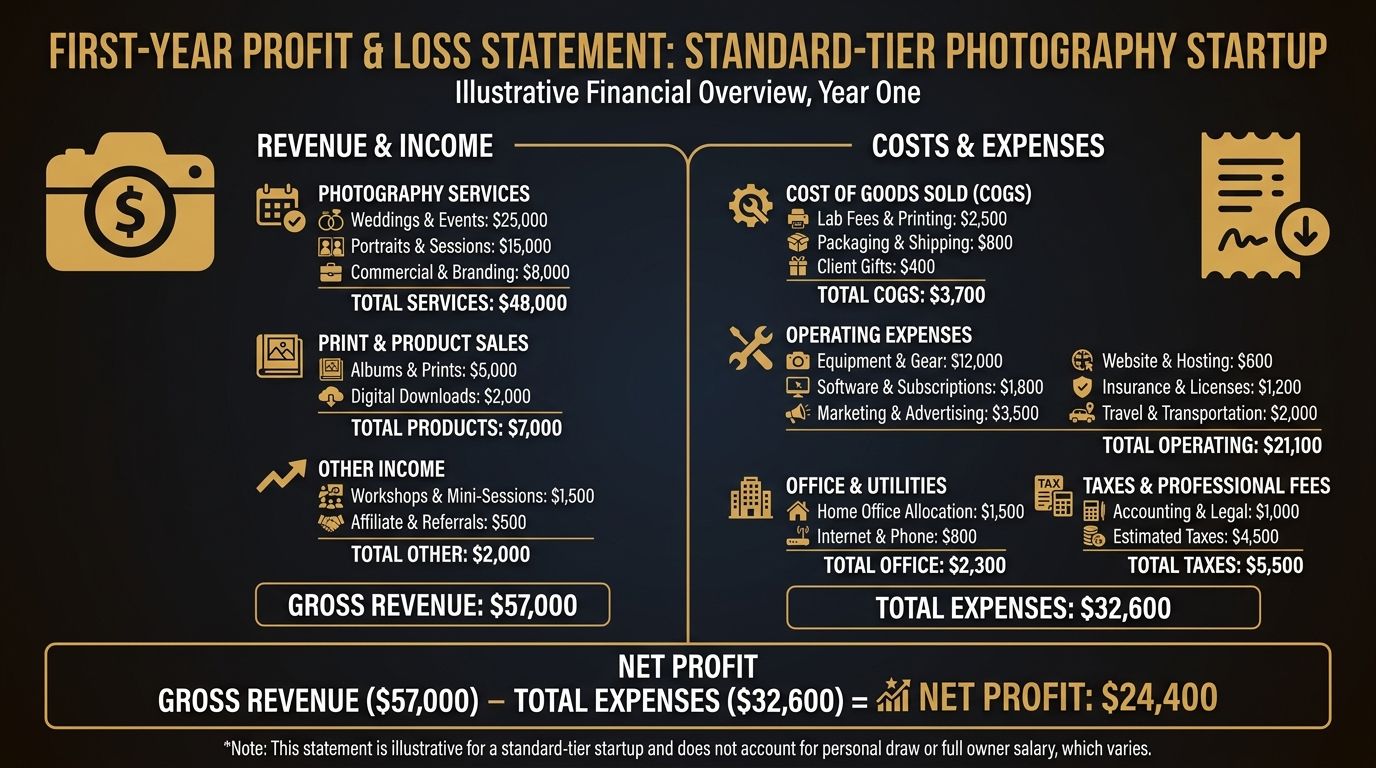
| Category | Amount |
|---|---|
| One-time startup costs (gear, computer, branding, registration) | $8,000 |
| Recurring annual operating costs (software, insurance, hosting, marketing) | $2,400 |
| **Total first-year costs** | **$10,400** |
| Gross revenue (40 sessions at avg $400) | $16,000 |
| **Net first-year result** | **+$5,600 (before taxes)** |
Illustrative scenario only. Actual revenue depends on local market rates, niche, marketing effort, booking volume, and pricing strategy.
⚠️ Your results will vary. This is a planning scenario based on typical ranges, not a guaranteed outcome. Many photographers post a small loss in their first year. Many post a small profit. A few hit much bigger numbers. The variable you control most directly is how aggressively you book and market in months 1–6.
Key Lessons from a Typical First Year
- Most photographers don't profit meaningfully in year one — and that's normal. Plan for it.
- The biggest variable is how fast you build referral momentum and fill your calendar
- Underpricing to build a portfolio is a common year-one trade-off, but it should be temporary, not your business model
- Track every expense from day one. It simplifies tax filing and shows you where the money is actually going
- Reinvest revenue into one or two targeted upgrades (a better lens, a CRM tool) rather than spreading it thin across ten small purchases
Frequently Asked Questions About Photography Business Startup Costs
How much does it cost to start a photography business in 2026?
Starting a photography business in 2026 typically costs between $2,000 and $20,000 depending on your niche and starting gear. A lean setup with one body, one lens, basic software, LLC registration, and insurance can launch for $2,000–$5,000. A full professional setup with backup gear, premium software, and a marketing budget runs $13,000–$20,000 or more.
Can you start a photography business with $1,000?
It's possible but tight. For $1,000 you could cover a used entry-level camera ($400–$600), one lens, a basic website, and business registration — assuming you already own a computer. You'd need to use free editing software and possibly defer insurance until your first revenue. This approach has real gaps in protection and professionalism, but it can work as a short-term stepping stone if you're already shooting on the side.
Do I need an LLC to start a photography business?
You're not legally required to form an LLC. A sole proprietorship is the default if you don't register anything. That said, an LLC provides personal liability protection if a client sues over property damage, injury, or a missed delivery. Most practicing pros form one before booking paid clients. State filing fees vary widely — check your state's Secretary of State website or the SBA's business registration guide for current costs.
How much does photography business insurance cost?
Photography business insurance costs vary based on niche, coverage limits, and location. General liability policies typically start around $200–$600 per year for basic coverage. Equipment coverage and professional indemnity are usually add-ons or separate policies. Get current quotes from Hiscox, Thimble, or through PPA membership for the most accurate rates for your situation.
What is the cheapest way to start a photography business?
The cheapest path is to use gear you already own, buy additional used equipment from reputable marketplaces like MPB or KEH, use free editing software like Darktable, and register as a sole proprietor before upgrading to an LLC. This can drop your startup costs under $1,500 if you already own a capable camera. Even on the lean tier, budget for liability insurance from day one — it's the one thing not worth skipping.
How long does it take a photography business to break even?
Break-even depends on your startup costs, average profit per session, and how many sessions you book each month. A simple estimate: divide your total startup cost by the net profit you expect per session. At a $6,000 startup cost and $200 net profit per session, you need 30 sessions to break even — roughly 6 to 15 months depending on booking volume. Most photographers don't fully profit in year one.
What equipment do I need to start a photography business?
At minimum: one reliable camera body, one or two lenses suited to your niche, memory cards, a backup storage drive, and a computer with editing software. Wedding photographers also need a backup camera body. Real estate photographers need a wide-angle lens and ideally a tripod. Product photographers need a controlled lighting setup. Buy the minimum required to book your first paying clients, then reinvest revenue into upgrades.
Are photography business startup costs tax-deductible?
Many startup costs are deductible. Equipment like cameras and lenses may qualify for Section 179 expensing in the year of purchase. Software subscriptions, insurance premiums, website hosting, qualifying home office expenses, and business mileage are also commonly deductible. Tax rules change annually and vary by situation — always consult a licensed CPA or tax professional before filing.
Sources
- Adobe Photography Plan – Official Pricing
- IRS Home Office Deduction
- IRS Section 179 Deduction Overview
- PPA Benchmark Survey – Professional Photographers of America
- Hiscox Photography Business Insurance
- SBA – Register Your Business
- MPB Used Camera Gear Marketplace
- LensRentals – Camera and Lens Rental Pricing
- DPReview – Camera and Lens Reviews
- PetaPixel – How to Start a Photography Business